
All Articles / Office Space: Licence Agreement vs Lease
Advice 7 min read

Office Space: Licence Agreement vs Lease

Licences vs. leases: We've got the pros and cons of each, so you can make an informed decision for your next office space, before you sign.

Photo of Laura Beales
Co-Founder, Tally Workspace
Published 15 Dec 2022 · Updated 22 Apr 2026

Key Takeaways

  • Licence agreements are short-term and flexible, ideal for businesses needing quick office solutions.
  • Commercial leases provide exclusive possession and greater security but involve higher upfront costs.
  • Understanding the terms of each agreement is crucial for making an informed decision.
When it comes to choosing between a licence agreement and a lease for your next office, there are a few key questions you should ask yourself: How long do I need the office space for? Am I looking for flexibility? What kind of overhead costs am I willing to accept?

Answering these questions will help you decide if a licence agreement or a commercial office lease is the right fit for your business. 


In this blog post, we’ve compared the two most common contracts so you can decide which is best for your company.

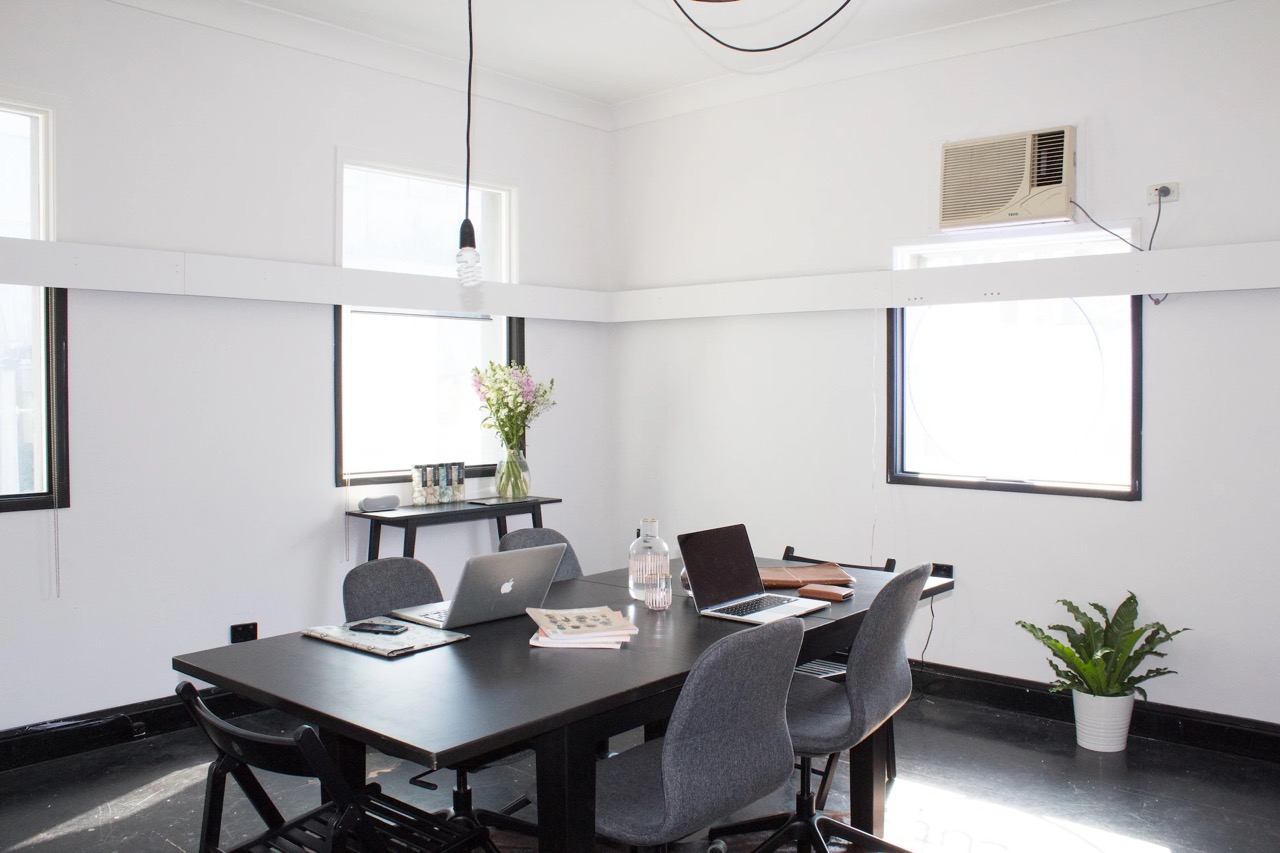
Meeting room on Tally Workspace

What is the difference between a licence agreement and a lease?

When it comes to renting an office space, there are two main types of agreements that you can use: leases and licences.

Both have their own benefits and drawbacks, so it's important to choose the right one for your needs. 


It’s worth noting that for most offices you won’t get to choose the type of agreement for your space; this will be determined by the building and how it's serviced.

So it's worth thinking about before you start your office search.  


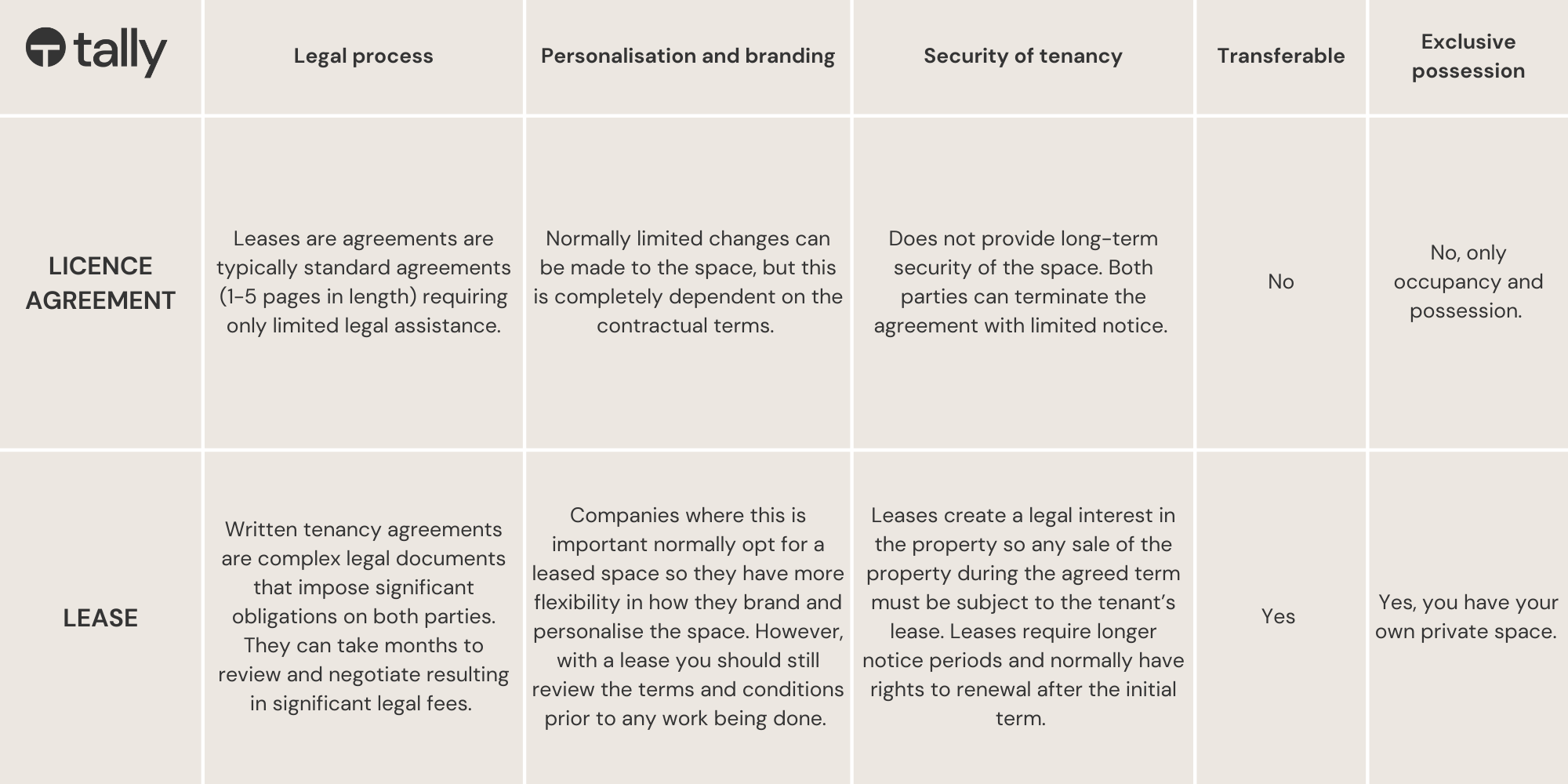
Here's a quick overview of the key differences between these two types of agreements.

Office space on Tally Workpace
What is a licence agreement?
Licence agreements are “licences to occupy” and are typically used for serviced offices or hot desks.

They are flexible and short-term agreements — typically less than 2 years.You'd expect to use a licence agreement if you were getting in an office space with a fully serviced provider such as WeWork, TOG, Huckletree, Runway East or X+Why.  The main advantage of a licence agreement is that it's quick and easy to set up and commit to.Licence agreements are also usually more flexible than other types of agreements, such as leases, which can make them ideal for businesses that are not sure how long they need the space for.

LABS Office Space on Tally Workspace

What's included in a licence agreement?

License agreements will state how long the license is valid for, how much rent is due each month, what is included (e.g. wi-fi, cleaning) and what activities are permitted on the property. Both parties need to understand these provisions, as they will have implications for all kinds of arrangements, from maintenance to repair costs to insurance coverage.

We recommend getting a lawyer to review the licence agreement so you are clear on the implications of all of the key terms. 


Breakout space on Tally Workspace

What are the benefits of licence agreements?

  • Good for companies who want a fully serviced workspace with a single monthly fee, licence agreements typically cover all-inclusive workspaces so you don't have to worry about bills and rates. 
  • If you are not ready to commit to a long-term lease. Licence agreements are normally for periods of less than two years, instead of the 5–10 years that you would expect if you were to take on an office lease
  • Licence agreements typically involve less paperwork and less stringent terms than traditional leases, making them a relatively straightforward process and good for businesses who want to move into an office space quickly.
  • Licence agreements can be easily renewed or terminated if necessary, making this a good choice for businesses looking for flexibility.

Office space on Tally Workspace

What are the negatives of licence agreements?

  • The terms on what you can do to the space are normally more limited than leases which means you can't make drastic changes to the space for branding or refurbishments
  • Licence agreements do not provide the same security of tenure as lease agreements. Whilst this rarely causes issues, it's worth being aware that were the licensor to dispose of their interest in the property, your right of occupancy would immediately cease.  
  • Licences are individual and linked to one company - they can't be transferred. 

What is an office lease?

An office lease is a legally binding contract where a company agrees to pay a landlord a rental amount to occupy and use space on an exclusive basis for a fixed term.

A lease details the rights, obligations, responsibilities, and financial implications for both parties.Unlike a licence agreement, the tenant will have the right to exclusive possession.

People coworking in a meeting room with sticky notes on Tally Workspace

What is included in a commercial office lease?

The lease will specify the length of the lease, square footage, rent amount, and associated fees.

The agreement will also say things like the hours of operation, what can and can't be done with the space, and what can and can't be done with subletting or assigning the lease.A commercial office lease typically requires a minimum term (usually at least 6 months). 


The tenant may also have to pay extra deposits to cover any losses the landlord might have if the rent isn't paid on time or if the place gets damaged while the tenant is living there.

Also, tenants are usually required to keep insurance coverage for public liability and damage to the property for the period of the lease. 


When looking for a commercial office lease, it's important to think about more than just the monthly rent and other fees.

You should also think about overhead costs like insurance premiums, utilities, and any extra taxes or rates you might have to pay because you're renting the space.


It's important that tenants fully understand what they are agreeing to before signing a commercial office lease, so they know exactly what their rights and obligations are throughout their term of occupancy.

Before signing a long-term office lease, companies should talk to a lawyer and ensure they understand all the terms and conditions. 

People working at the office on Tally Workspace

What are the benefits of commercial office leases?

  • Having exclusive occupation means that tenants can make changes to their space as they desire and make it feel fully on-brand without having to worry about accommodating another business.
  • With a longer lease term, overall costs may be reduced due to less frequent renewals or relocation costs.
  • A commercial office lease can also offer flexibility when it comes to subletting or assigning unused space if tenants choose not to utilise it. This is beneficial, particularly for businesses that may require extra space during peak periods or need more room when expanding operations. However, if this is one of the reasons you are opting for a lease you must get legal advice to ensure this is possible under the specific terms of your lease. 
  • Leases provide greater security. When signing a lease you create a legal interest in the property so any sale of the property during the agreed term must be subject to the tenant’s lease.  

Office space corridor on Tally Workspace

What are the negatives of commercial office leases?

  • Perhaps the most significant disadvantage is the upfront costs associated with a commercial lease including agent's fees, legal fees and fit-out costs. Agent's fees are typically charged by a real estate agent to facilitate the transaction between landlord and tenant. Fit-out costs for renovations or modifications that need to be made for the tenant to use the property can be high. These may range from repainting walls to adding fixtures or furniture. 
  • Another issue is complex legal processes. There is often a negotiation process over terms such as length of lease and renewal options which can take weeks or even months before an agreement is reached.
  • Move-in time is significantly higher than for licence agreements. It typically takes 3-12 months from the signing of the contract before it is possible for the tenant to move into their new premises; this period includes the time needed for fit-outs and other administrative work.
  • Less flexibility can also cause issues e.g. if undesirable neighbours move into a nearby property, with no recourse, tenants may find themselves stuck in a property they no longer want. 
  • In some cases leases may include clauses regarding rent increases should certain conditions arise (such as if additional commercial properties become available in close proximity). If those conditions arise then landlords have both legal privilege and financial incentives to raise rents significantly above market rate; such jumps in rent can quickly put businesses under financial pressure if their cash flows cannot accommodate them. 
  • Dilapidations costs when the lease ends. Dilapidations refer to charges levied by the landlord at the end of the lease period if damage has been done to the property; these are often not negotiable and must be paid in full prior to vacating. 

People coworking at the office on Tally Workspace

Which is better: a licence agreement or a lease?

Ultimately, the decision of whether to sign a licence agreement or a lease depends on the specific needs of the business.

Licence agreements are typically shorter than leases, and they offer more flexibility in terms of use and length of stay.However, licence agreements also tend to be more expensive in the short term, and they often don't include any provisions for renewing or extending the agreement.Office leases, on the other hand, are usually longer-term agreements that can provide some stability and predictability in terms of cost.But leases can be inflexible, and they may require a business to make significant renovations or changes to the space.To help you decide what's best for your business, here's a handy table with the key features of both. 
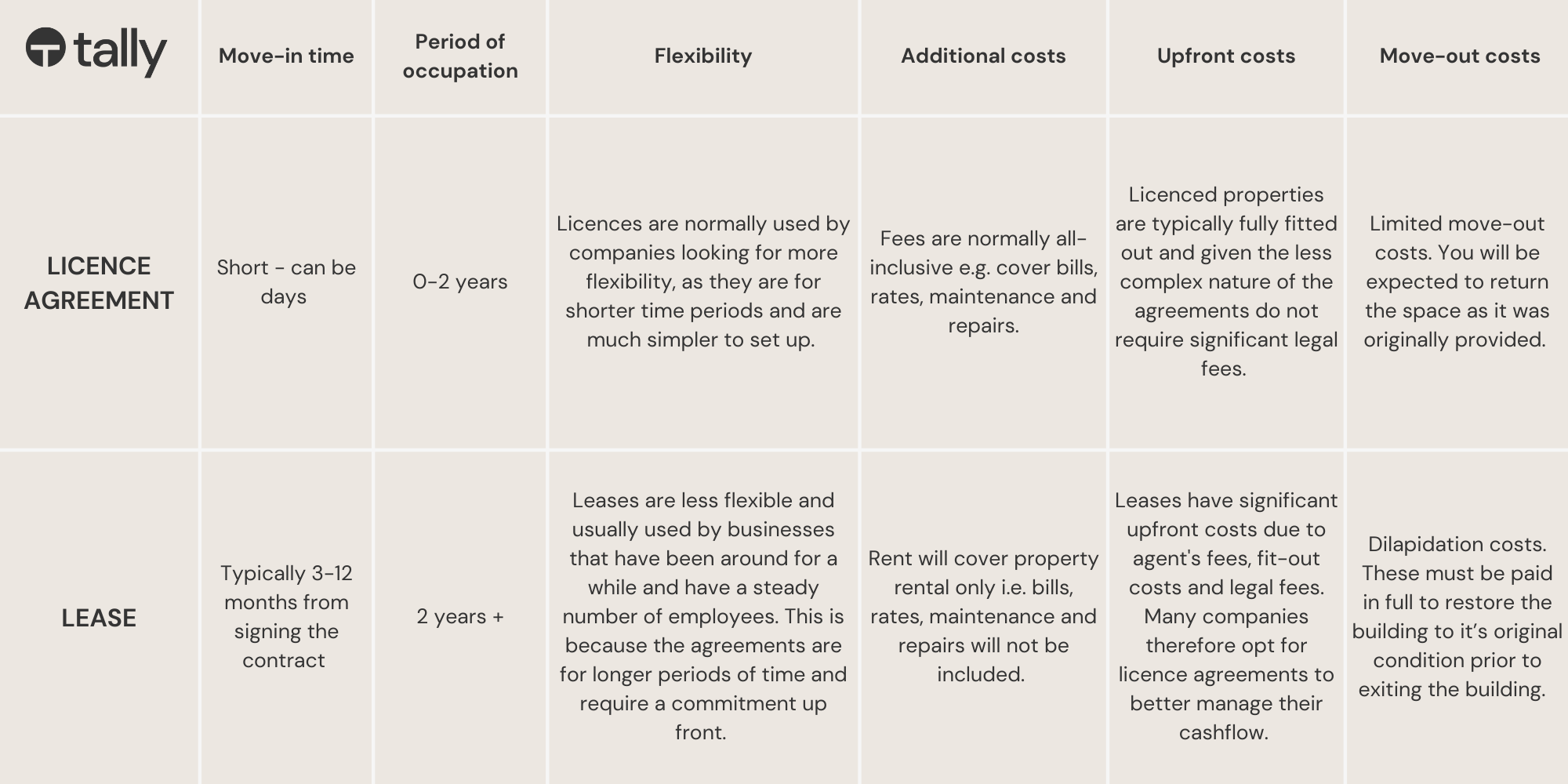

Summary of lease vs licence agreement

Licence agreement vs lease comparison table

FAQs

Which is cheaper, a licence agreement or a lease?

While the list price for a leased property is normally lower, it excludes additional costs such as rates, fit-out, legal fees, dilapidations, cleaning, etc. 

Due to all the additional management that needs to be done to maintain a leased office, companies normally hire an office manager, whose cost should also be considered when comparing the different options.  

We recommend calculating the following costs to ensure you are comparing like with like: 
  • Rental rates 
  • VAT
  • Business rates 
  • Utility/energy bills 
  • Water rates 
  • Phone line 
  • Deposit 
  • Insurance (buildings and contents) 
  • Fit-out costs 
  • Furniture and equipment 
  • Cashflow costs (especially if paying for large fit-out or deposit) 
  • Professional fees e.g legal fees, surveyors, agents 
  • Repairs and maintenance
  • Wi-fi costs 
  • Cleaning 
  • Local authority charges e.g. waste disposal or parking 
  • Office manager or any additional staff costs to manage the space 
  • Dilapidations 
  • SDLT on leases (charged when a lease exceeds a certain value)
  • Meeting room costs (some share office spaces offer free meeting rooms or meeting room credits but where this is not the case or you have high meeting room usage it can quickly pay off to have your own internal meeting room)

two ladies coworking at the office on Tally Workspace

How do I check if I am entering into a lease or licence agreement? 

Licence agreements normally state that they are licence agreements, as landlords are keen to make this clear.

However, the courts will look at the substance and form of the underlying agreement to determine whether the document is a licence or lease.  


The key differences between a licence and a lease are that leases are:
  1. Exclusive possession
  2. Of defined premises
  3. For a term which is certain (either fixed term or periodic tenancy)

Source: (Cognitive law

What is exclusive possession?

A company has exclusive possession of a piece of property if it has the right to keep the landlord and other people from entering.

Usually, the lease will also have clauses that give the landlord the right to enter the property for certain reasons, such as to make repairs. 


Two men coworking at the office on Tally Workspace

My licence states that the office company can change which office I am based in; should I be concerned?
Licence agreements normally state that the landlord retains the right to move the licensee around within the area identified by the licence.

This is written into license agreements so that the licensee isn't given ownership of a specific area and the courts don't see the document as a lease. If you're looking for a new office space your whole team will love, let us know yourrequirements here.No matter how soon you want to move or what is important to you, we'll be able to match you up with the perfect new space.

Photo of Laura Beales

Written by Laura Beales

Co-Founder, Tally Workspace

Laura Beales is the Co-Founder of Tally Workspace, bringing a unique blend of financial expertise and real estate knowledge to the office space industry. A qualified Chartered Accountant, Laura began her career in finance but transitioned into commercial property after experiencing first-hand the inefficiencies and lack of transparency in the market from a customer perspective.

View full profile →

Get free expert advice with your office search

  • Real experts, not algorithms
  • We negotiate on your behalf
  • Off-market access
  • No broker fees
Send me a shortlist →

Share

Related articles

View all

Companies that chose
Tally Workspace

From first office to scale-up headquarters, we have been there.

Butternut Box

Secured a 14,000 sq ft CAT A leased HQ at White City Place

Introduced to 3 specialist fit-out partners, including Thirdway

Full market review spanning White City, Hammersmith & Soho

"Much like Butternut Box's brand, the project intent has been to pair a deeply human playfulness with elevated, premium design. Together we've crafted a joyful space which can bring out the best in all users, whether they be two or four legged."

Creative Director at Thirdway

View case study
Cryptio

£11,700 saved through negotiation

10+ shortlisted options delivered within hours

Office signed within 2 weeks of first contact

"Tally helped us find our new office at lightning speed. Jules, Laura, and the team are the best at what they do. We wanted a rooftop, natural light, a central location, and a good deal. They got us 10+ solid options within 48hrs and scheduled all the viewings. We found our new space within 2 weeks."

CRO at Cryptio

View case study
FIXR

Full market review across serviced, managed and leased office options

Custom layout designed by a workspace specialist - at no extra cost

Secured a self-contained 1,850 sq ft space in Leicester Square

"Tally Workspace exhausted the market and found us just what we were looking for within weeks. They were a breath of fresh air, extremely knowledgeable and helpful, and even assisted with design and fit-out. Very proactive at every stage, like an extension of our own team."

Ed Glover, CEO of FIXR

View case study
Sifted

Secured a 2,000 sq ft self-contained HQ in Shoreditch

Workspace designer sourced and managed as part of the service

Used Tally Workspace on-demand between offices

"Tally Workspace has been an incredible help for Sifted. From understanding the office/remote first landscape to finding the right office for all of our requirements."

Chief of Staff at Sifted

View case study
365 Finance

Negotiated a 43% discount on the list price

Shortlisted options across Marylebone, Victoria, Waterloo & Holborn

Secured a 60-desk office with internal meeting rooms in TCR

"You made this whole project smooth and actually enjoyable. You're well connected, which opened up options we wouldn't have found ourselves. I'm confident we would have missed this fantastic opportunity without your help, and you secured us a much better price than we could have achieved directly."

Group Head of HR at 365 Finance

View case study
"I'd say it is a no brainer! A win win to use Tally Workspace to find your next space. No additional cost but endless extra value."

Founder & Lightning

"Not only are they very knowledgeable about the market, but they're lovely people to deal with. We're so happy with our final choice and can't wait to move!"

Finance Unlocked

"The space they found was perfect for our team, with loads of amazing breakout space, beautiful meeting rooms and a real emphasis on wellbeing."

Florence

"They got us 10+ solid options within 48hrs and scheduled all the viewings. Highly recommend. We found our new space within 2 weeks."

Cryptio

How Tally Workspace works

Tell us what you need

Team size, budget, location, and deal breakers. We'll ask about the things most people forget too.

searching...

We handle the search

We search our proprietary database then call landlords directly about unlisted spaces. Often back to you within a day.

We handle the detail

Contracts are where most searches fall apart. We review everything and negotiate before you sign.

You move in confident

Best space, best terms, timeline that fits your growth. You know exactly what you're signing.

Tell us what you're looking for

Find an office today

Using our extensive mapping of startup and scaleup office space, find an office that fits your needs and your culture in just a few minutes.

Search all offices