

Two of the biggest names in flexible office space. Very different experiences. Here's what you actually need to know before you decide.
WeWork and Regus dominate conversations about flexible office space in the UK — and for good reason. Between them, they cover thousands of locations, millions of square feet, and a huge range of working styles. But choosing between them isn't straightforward, because they're built for different kinds of businesses, different cultures, and different ways of working.
Whether you're a founder looking for your first proper office, an Operations Manager scouting space for a growing team, or a scaling business that needs flexibility without a long-term lease, this guide will help you figure out which provider — if either — is the right fit.
Are WeWork and Regus the same company?
No. They're entirely separate businesses with different ownership, different models, and a very different feel.
WeWork was founded in New York in 2010 and built its reputation on community-led, design-forward workspaces. Regus was founded in Brussels in 1989 and grew into one of the world's largest flexible office networks, with a more corporate, functional approach.
They both offer flexible office space. That's largely where the overlap ends.

WeWork: Workspace with a culture built in
Walk into a WeWork and you'll notice it immediately. The exposed brickwork. The barista counter. The buzzy, open-plan energy. WeWork has always positioned itself as more than just a place to work — it's a workplace culture in itself.
Their spaces are designed to encourage interaction. Breakout areas, event spaces, phone booths, and glass-walled meeting rooms sit alongside private offices. Regular networking events, socials, and member perks are part of the package. If your team thrives on energy and connection, WeWork delivers that in spades.
It's particularly popular with startups, creative agencies, and scaling teams who want a workspace that reflects where their business is going — not just where it is today.
Where is WeWork in the UK?
WeWork operates across 5 UK cities: London, Manchester, Birmingham, Cambridge, and Edinburgh. A membership gives you access to any WeWork location globally, which is a real perk if your team travels regularly or works across multiple cities.
WeWork membership options
- On-demand: Pay-as-you-go access to hot desks and meeting rooms
- All-access pass: Unlimited monthly use of shared spaces across all locations
- Dedicated desk: Your own fixed desk in a shared workspace
- Private office: Plug-and-play private offices for teams of up to 100
- Whole floor: A fully self-contained floor with meeting rooms and breakout zones

Regus: Flexibility and reach, at scale
Regus is quieter, more structured, and more corporate in feel. Neutral tones, private offices, and a no-fuss setup that's designed for focused, heads-down work.
If your team values privacy over buzz, or if your clients expect a polished, professional setting, Regus delivers that consistently. It's the kind of space where a boardroom meeting feels appropriate — and where a loud team brainstorm might feel slightly out of place.
Regus appeals to a wide range of businesses: SMEs, established companies, and corporates who need reliable, functional space without the lifestyle extras.
Where is Regus in the UK?
This is where Regus really pulls ahead. With over 300 locations across the UK — from Aberdeen to Brighton, Wigan to Southampton — Regus has the most extensive network of any flexible office provider in the country. If regional access matters to your business, Regus is hard to beat.
Regus membership options
- Virtual office — A professional business address with mail handling and call services, no physical desk needed
- Lounge pass — Drop-in access to any Regus business lounge
- Coworking pass — Monthly access to a shared coworking desk
- Private office — Fully serviced private offices with access to shared amenities
Key differences between WeWork and Regus
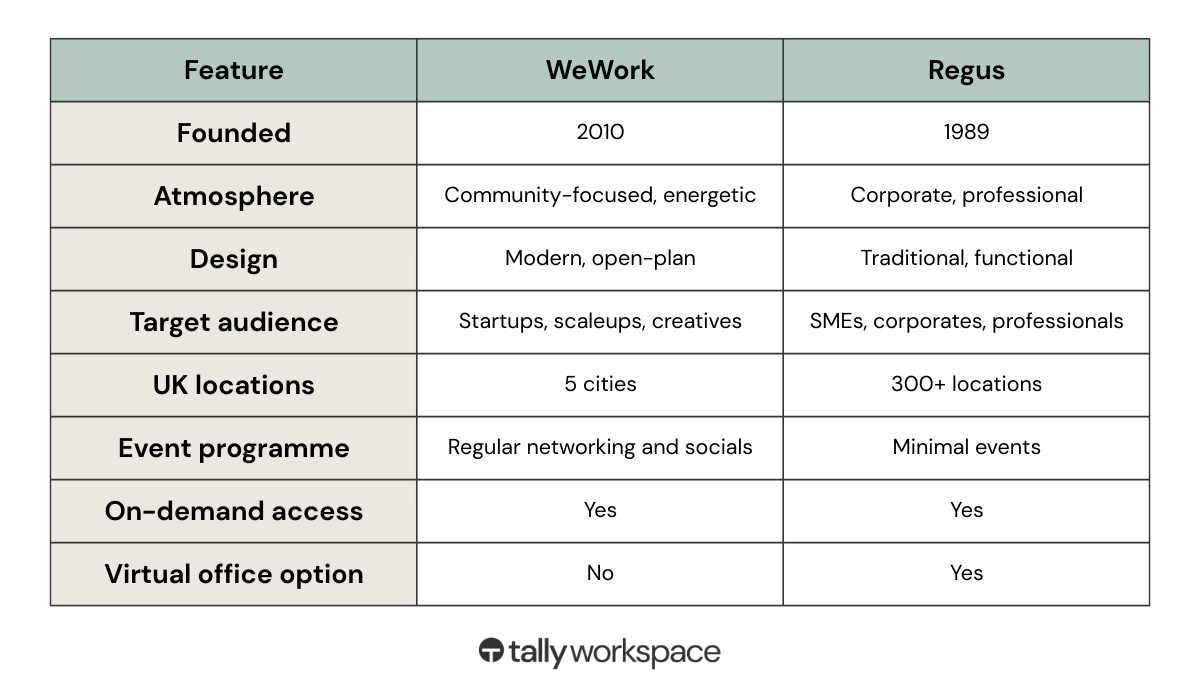
Both providers cover the flexible office basics — private offices, coworking desks, meeting rooms, and short-term contracts. But the day-to-day experience of working in a WeWork versus a Regus is quite different. Here's a side-by-side breakdown of the key factors to consider.
Pros and cons of WeWork and Regus
Every office space has its strengths — and its trade-offs. Here's an honest look at what WeWork and Regus each do well, and where they fall short.
WeWork
WeWork has built a strong following among startups and creative teams, and it's easy to see why. But it's not the right fit for everyone.
Pros
- Genuinely inspiring, modern, collaborative environments
- Strong community feel — great for networking and serendipitous connections
- Flexible membership options, from hot desks to whole floors
- Access to all WeWork locations worldwide
Cons
- The open, energetic atmosphere can be distracting for deep-focus work
- The informal vibe doesn't suit every business type or client-facing need
Regus
Regus takes a different approach — quieter, more corporate, and built around reliability. Here's where that works in your favour, and where it doesn't.
Pros
- Enormous UK network — coverage almost everywhere
- Quiet, professional atmosphere suited to focused work
- Virtual office option is useful for remote or part-time teams
- Straightforward, no-frills setup
Cons
- Community perks and social events are limited
- Spaces can feel functional rather than inspiring
WeWork or Regus: Which is right for your business?
Here's the honest answer: it depends on what your team needs day-to-day.
Choose WeWork if your culture is collaborative, your team is growing fast, and you want a workspace that has energy built into it. It works particularly well for startups and scaleups who want their office to feel like part of their identity.
Choose Regus if you need professional, quiet space — whether that's office space in Farringdon or coverage in cities WeWork simply doesn't reach. It's also the stronger choice if a virtual office address is on your wishlist.
And if neither feels quite right? That's worth paying attention to. WeWork and Regus are two options in a much bigger market. There are independent coworking spaces, boutique serviced offices, and managed office solutions that might suit your team far better — and often at a more competitive price.
What else should you consider?
Before you sign anything, it's worth thinking beyond the headline membership cost.
- Culture fit matters more than people expect. The energy of your workspace affects how your team feels about coming in. An office that feels right for your business can make a real difference to morale, productivity, and even hiring.
- Location and commute are still the number-one factor for most employees. A great office that's hard to get to will always struggle with attendance. Think about where your team actually lives — and where your clients are based.
- Room to grow is essential if you're scaling. Signing into a space that fits your team today but can't accommodate growth in 6 months will cost you time, money, and disruption.
- Flexibility in the contract is something both WeWork and Regus offer — but the specifics vary by location and membership type. Always read the small print before committing.
Need help comparing options?
WeWork and Regus are two of the most well-known names in flexible office space — with locations from office space in Fitzrovia to regional hubs nationwide — but they're not the only options, and they're not always the best fit for every business.
At Tally, we work with startups and scaling businesses across the UK to find office spaces that genuinely suit their teams, their culture, and their budget. We know the market inside out, and we're completely independent — so the advice you get from us is honest.
Talk to the Tally team and let's find the right space for you.