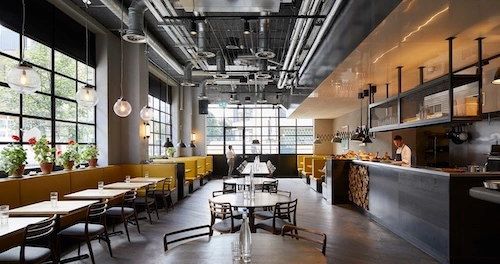
Cat A fit outs make an office safe and compliant but require further work to be occupiable.
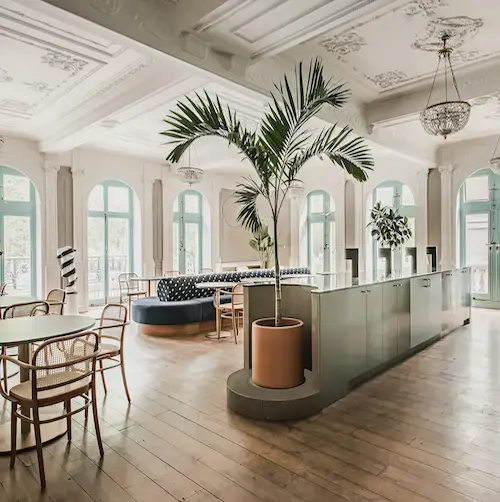
Cat A+ offers furnished plug-and-play spaces for quicker occupancy.
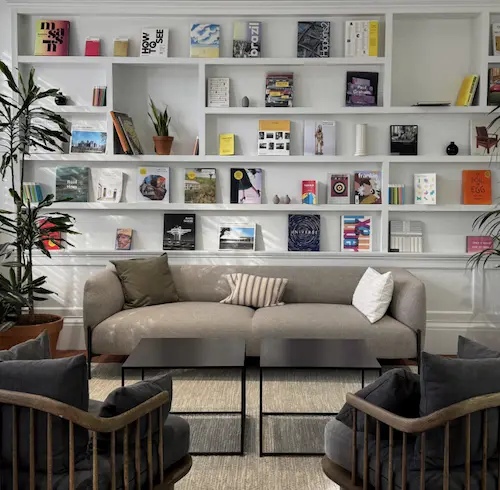
Cat B fit outs are fully customized to meet specific business needs and functionality.
Key Takeaways
Cat A fit outs provide essential services and finishes that make an office safe, compliant, and functional – but not yet occupiable without further work.
Cat A+ bridges the gap between Cat A and Cat B – offering plug-and-play spaces with furnishings and some infrastructure in place.
Cat B fit outs are fully bespoke, tailored to a business’s needs, including layout, branding, and operational functionality.
Shell and Core is the raw structural shell of a building, requiring a full internal fit out before use.
Deciding your fit out strategy early in your search helps avoid delays, unplanned costs, and signing a lease on the wrong type of space.
Introduction
When planning an office move or searching for a new workspace, understanding the differences between fit out categories is crucial. The type of fit out you choose – Cat A, Cat A+, Cat B, or Shell and Core – determines how quickly you can move in, how much customisation is possible, and how much of the project you will need to manage yourself. This guide will walk you through the distinctions, considerations, and practical steps involved in each option to help you make an informed decision.
Why Your Fit Out Strategy Should Be Decided Early
One of the most critical — and often overlooked — decisions in the office search process is determining what type of space best suits your business needs from the outset. Whether you opt for Shell and Core, Cat A, Cat A+, or Cat B, the category you commit to will influence:
The types of properties you shortlist
The project timeline and move-in date
Your internal resourcing and responsibilities
The level of input you need from consultants or fit out specialists
The total budget (including capital expenditure and operational costs)
Failing to define your fit out strategy early can lead to delays, unplanned costs, or even signing on to the wrong type of space. For example, leasing a Cat A space without realising the time and effort required to deliver a Cat B transformation can create serious operational disruption — especially if you're working towards a fixed deadline or have limited internal capacity to manage the process. When planning a fit out, it’s important to ensure your space is correctly sized for your team’s needs. Our Office Space Calculator can help estimate the ideal amount of space before you begin detailed design planning.
Questions to ask early:
How soon do we need to be operational?
Do we have internal capacity to manage a fit out project?
Should we appoint a project manager or workplace consultant?
What is our total budget, including fit out costs?
How involved do we want to be in design and procurement?
Being clear on your fit out strategy from the outset helps avoid unsuitable property options and ensures you plan for a realistic timeline.
Fit Out Types at a Glance
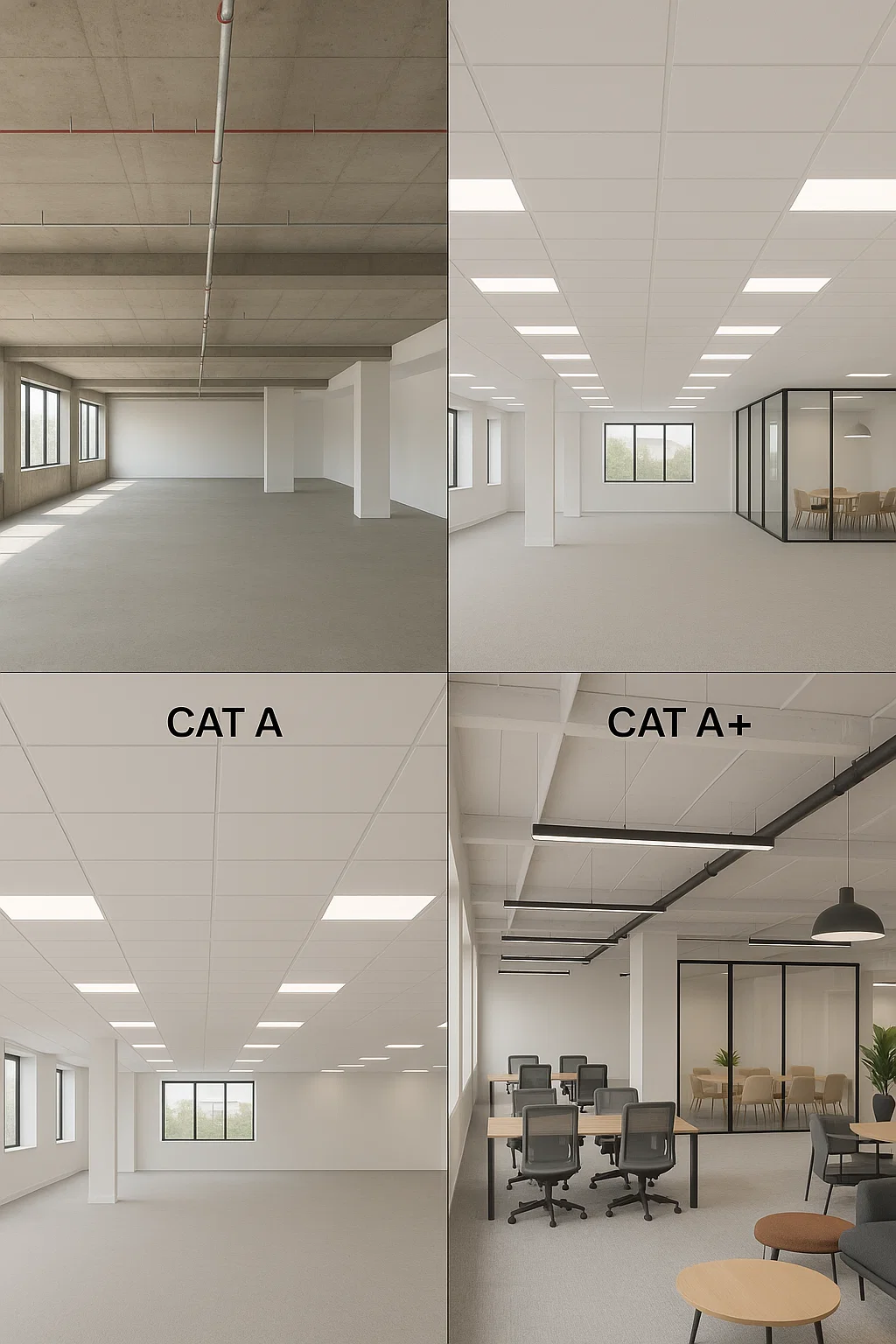
Side-by-side comparison of Shell & Core, Cat A, Cat A+, and Cat B office fit outs showing different levels of workplace readiness
Shell and Core
Shell and Core is the most basic form – a structural shell with no internal finishes or services. Suitable for pre-lets or full HQ builds, it offers complete flexibility but requires significant capital and time.
Cat A
Cat A includes basic services like ceilings, lighting, and HVAC. It provides a blank, compliant shell that requires further work to become occupiable. Ideal for businesses wanting full design control but prepared for longer timelines.
Cat A+
Cat A+ builds on Cat A with furnishings, kitchens, and partitions. Aimed at plug-and-play use, it offers faster occupancy and less management, ideal for smaller teams or short leases.
Cat B
Cat B is the full fit out: everything from design to IT infrastructure and branded finishes. It delivers a ready-to-operate space and is ideal for long-term tenants with specific layout and cultural requirements.
Fit Out Types in Detail Shell and Core?
Shell and Core describes the earliest stage of commercial property development. The building is structurally complete but lacks internal finishes, services, and tenant-specific infrastructure. Essentially, it’s an empty box – offering maximum flexibility but requiring substantial investment before use.
New developments or refurbishments awaiting tenant input
Large pre-lets where the tenant takes full responsibility for interior design
Build-to-suit projects where customisation is negotiated from inception
For most SMEs or traditional leaseholders, Shell and Core is not a practical starting point. However, it can be ideal for corporate HQs, tech campuses, or long-term anchor tenants with very specific design requirements.
What is a Cat A Office Fit Out?
A Category A (Cat A) fit out refers to the landlord’s standard finish of an office space. It’s the base level required to make a commercial space safe, compliant, and ready for internal design and build work.
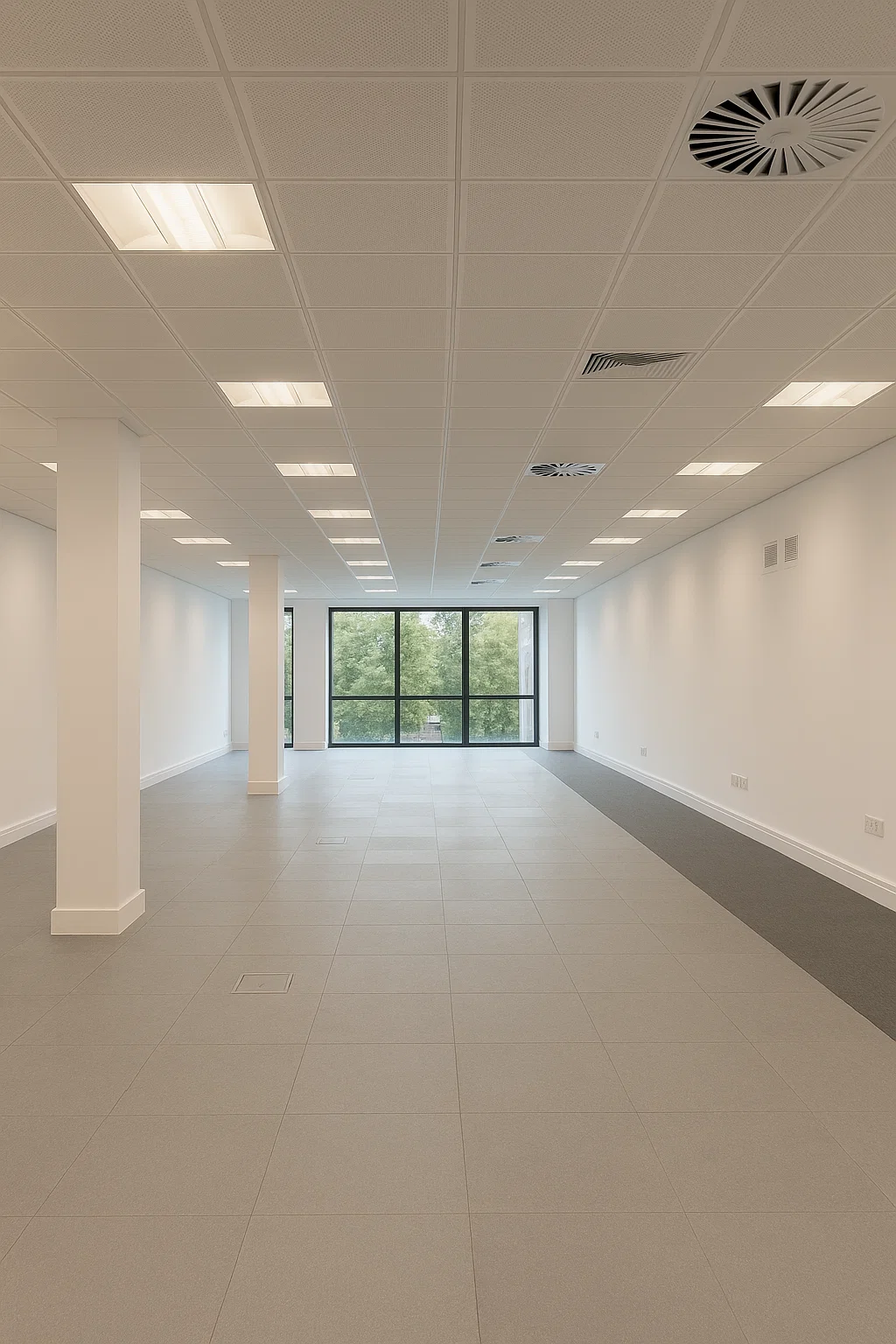
Modern Cat A office fit out with exposed ceilings, raised floors, and suspended lighting in a newly refurbished commercial space
What does a typical Cat A fit out include?
Suspended ceilings with recessed lighting
Raised access floors, often metal tile, for flexible cable management
Painted perimeter walls
HVAC systems for heating, ventilation and air conditioning
Fire alarms, smoke detectors, and emergency lighting
Floor-to-ceiling glazing (where applicable) for natural light
Common parts such as lift lobbies and shared receptions
The main purpose of a Cat A fit out is to hand over a space that complies with regulations, supports building services, and gives the tenant a blank but functional space to personalise.
Common use cases for Cat A
Landlord re-lettings – quickly re-preparing spaces for new tenants
Pre-lets – allowing tenants to begin from a neutral base
Dilapidations – restoring a previously tenanted space to an agreed standard
Key benefits
Neutral appeal – easy for agents to market to a broad tenant base
Cost-effective and efficient – especially when dealing with multiple units
Flexible handover – allows tenant-led customisation via Cat B fit out
Faster project timelines – suitable for standard office layouts
However, while Cat A spaces may look complete, they are rarely functional from a day-one operational perspective. There are no workstations, partitioning, or IT – which means a business cannot realistically occupy the space until a further fit out is completed.
What is a Cat A+ Fit Out?
Cat A+ is a relatively new addition to the office fit out lexicon. It is designed to respond to the growing demand for turnkey, flexible office solutions that sit somewhere between basic infrastructure and bespoke design.
In essence, Cat A+ offers a lightly fitted and furnished office space that’s ready for immediate occupation, often with short-term lease structures or flexible terms.
What’s typically included in a Cat A+ space?
Soft and hard furnishings (desks, chairs, breakout seating)
Fitted kitchen or tea point
Meeting pods or basic glazed rooms
Plug-and-play internet access and cabling
Storage walls or shelving units
Limited acoustic treatments
Who is Cat A+ ideal for?
Start-ups and SMEs that want to avoid upfront capital expenditure
Businesses scaling or in transition that need short-term flexibility
Landlords looking to attract tenants in competitive markets or reduce voids
Companies moving quickly and looking to avoid long procurement processes
Cat A+ has become especially popular in urban hubs such as London, Manchester, and Bristol, where agility and speed to market are often key decision factors.
What is a Cat B Office Fit Out?
A Category B (Cat B) fit out is where a workspace becomes your workspace. This is the phase where design, functionality, and company culture come to life. The goal of a Cat B project is to create a tailored, fully branded environment optimised for productivity, collaboration, and wellbeing.
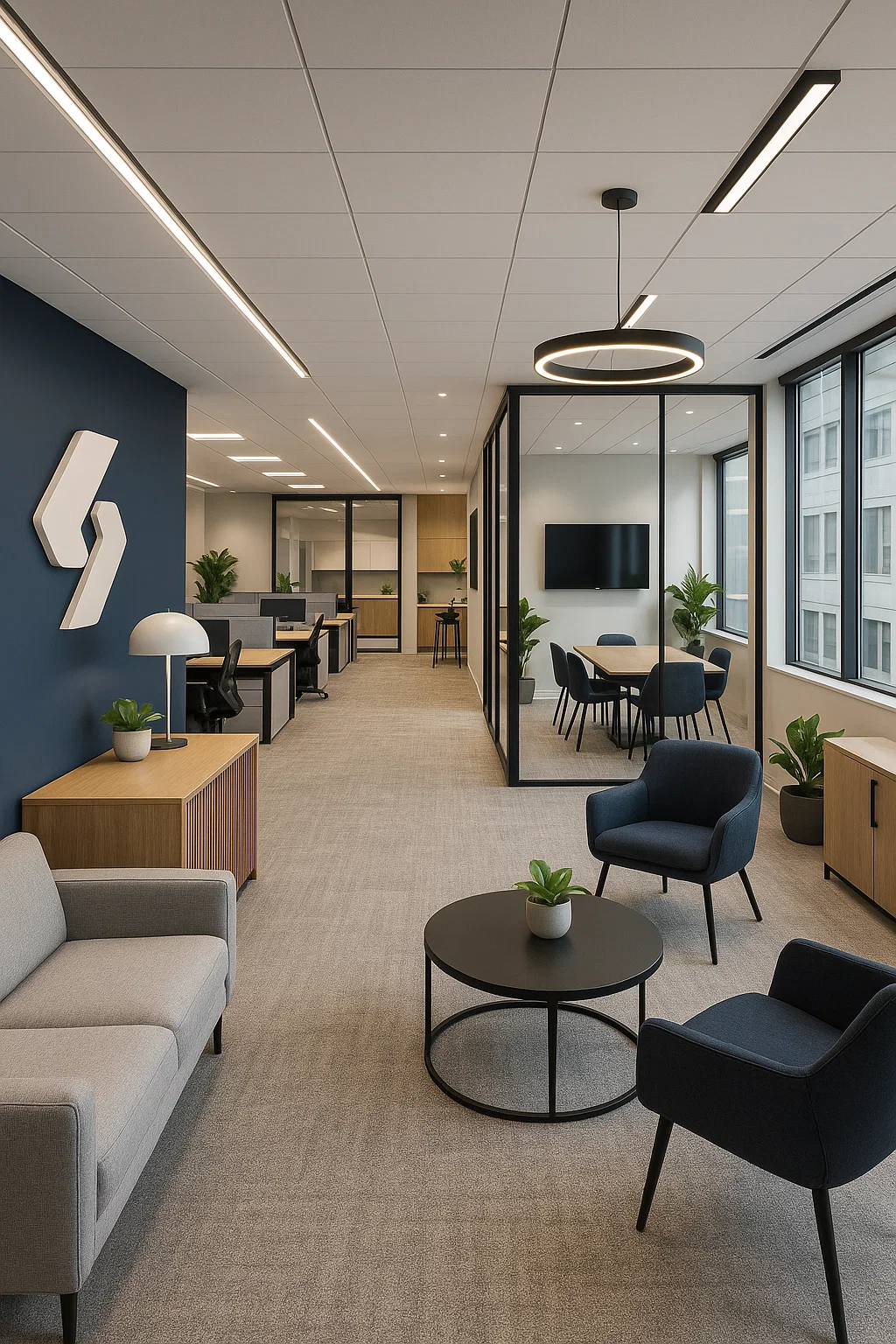
Cat B office fit out with open-plan desks, glass meeting room, breakout seating area, and modern furniture in a tenant-ready space.
Common inclusions in a Cat B fit out
Workspace strategy and space planning (team zones, circulation)
Internal partitioning for meeting rooms, quiet zones, and offices
Bespoke joinery and finishes (flooring, wall treatments, signage)
Furniture selection and installation
Audio-visual and IT infrastructure (screens, cabling, security)
Branding – from colour schemes to digital displays
Wellness features – such as biophilia, acoustic design, and ergonomic seating
Sustainability features – such as reuse of materials or WELL certification
Cat B fit outs are typically initiated when:
A company moves into a Cat A space provided by a landlord
A business needs to reimagine or upgrade its existing office
A new HQ or flagship location is being launched
The case for Cat B
Customisation – from layout to look and feel
Brand embodiment – the physical expression of company values
Optimised performance – spaces designed around workflows and culture
Recruitment and retention – quality workspace is a talent asset
While Cat B fit outs involve more time, capital, and complexity, the ROI in terms of team performance, wellbeing, and brand representation is often significant.
Explore office space in London
Priority neighbourhoods with deep coverage across the city.
Laura Beales is the Co-Founder of Tally Workspace, bringing a unique blend of financial expertise and real estate knowledge to the office space industry. A qualified Chartered Accountant, Laura began her career in finance but transitioned into commercial property after experiencing first-hand the inefficiencies and lack of transparency in the market from a customer perspective.
From first office to scale-up headquarters, we have been there.
Secured a 14,000 sq ft CAT A leased HQ at White City Place
Introduced to 3 specialist fit-out partners, including Thirdway
Full market review spanning White City, Hammersmith & Soho
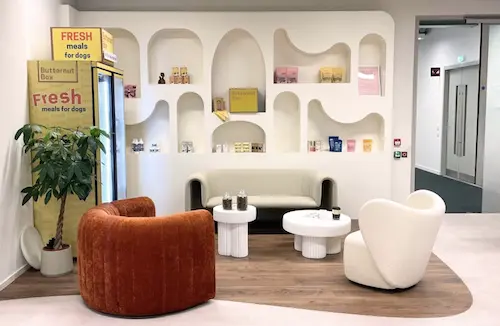
"Much like Butternut Box's brand, the project intent has been to pair a deeply human playfulness with elevated, premium design. Together we've crafted a joyful space which can bring out the best in all users, whether they be two or four legged."
"Tally helped us find our new office at lightning speed. Jules, Laura, and the team are the best at what they do. We wanted a rooftop, natural light, a central location, and a good deal. They got us 10+ solid options within 48hrs and scheduled all the viewings. We found our new space within 2 weeks."
Full market review across serviced, managed and leased office options
Custom layout designed by a workspace specialist - at no extra cost
Secured a self-contained 1,850 sq ft space in Leicester Square
"Tally Workspace exhausted the market and found us just what we were looking for within weeks. They were a breath of fresh air, extremely knowledgeable and helpful, and even assisted with design and fit-out. Very proactive at every stage, like an extension of our own team."
Secured a 2,000 sq ft self-contained HQ in Shoreditch
Workspace designer sourced and managed as part of the service
Used Tally Workspace on-demand between offices
"Tally Workspace has been an incredible help for Sifted. From understanding the office/remote first landscape to finding the right office for all of our requirements."
Shortlisted options across Marylebone, Victoria, Waterloo & Holborn
Secured a 60-desk office with internal meeting rooms in TCR
"You made this whole project smooth and actually enjoyable. You're well connected, which opened up options we wouldn't have found ourselves. I'm confident we would have missed this fantastic opportunity without your help, and you secured us a much better price than we could have achieved directly."
"I'd say it is a no brainer! A win win to use Tally Workspace to find your next space. No additional cost but endless extra value."
Founder & Lightning
"Not only are they very knowledgeable about the market, but they're lovely people to deal with. We're so happy with our final choice and can't wait to move!"
Finance Unlocked
"The space they found was perfect for our team, with loads of amazing breakout space, beautiful meeting rooms and a real emphasis on wellbeing."
Florence
"They got us 10+ solid options within 48hrs and scheduled all the viewings. Highly recommend. We found our new space within 2 weeks."
Cryptio
How Tally Workspace works
Tell us what you need
Team size, budget, location, and deal breakers. We'll ask about the things most people forget too.
searching...
We handle the search
We search our proprietary database then call landlords directly about unlisted spaces. Often back to you within a day.
We handle the detail
Contracts are where most searches fall apart. We review everything and negotiate before you sign.
You move in confident
Best space, best terms, timeline that fits your growth. You know exactly what you're signing.
Tell us what you're looking for
Find an office today
Using our extensive mapping of startup and scaleup office space, find an office that fits your needs and your culture in just a few minutes.