Senior Advisor - Commercial Real Estate, Tally Workspace
Published 4 Dec 2025·Updated 4 Dec 2025
Key Takeaways
Traditional office leases provide stability and ownership over the workspace, suitable for companies with clear growth plans.
Tenants are responsible for fit-out, utilities, and maintenance, requiring careful planning.
A realistic timeline for securing a leased office is typically 3–9 months, allowing for thorough negotiation and planning.
Traditional office leases remain a core option for businesses that want stability, control, and a long-term base for their team. They offer a level of ownership over your environment that flexible workspaces can’t deliver, which is why they continue to suit companies with clear growth plans, consistent headcount, and a need for a space that feels entirely their own.
This guide breaks down how traditional leases work, what costs to expect, the timelines involved, and how to decide whether this route fits your organisation. If you’re considering a leased office, this is everything you need to know before getting started.
What is a traditional office lease?
A traditional lease is a long-term agreement between a business (the tenant) and a landlord for exclusive use of a self-contained office space. The tenant takes responsibility for the space itself and the associated running costs. It creates a fixed, predictable home for your team that you can adapt to your culture, workflows, and long-term goals.
Traditional leases are the format most people think of when they imagine renting an office — multi-year commitments, full control over the design, and direct relationships with landlords and building management teams.
Key characteristics of traditional office leases:
Lease terms typically run for 3–10 years.
The tenant has exclusive use of the space.
You manage the fit-out, utilities, maintenance, and day-to-day operations.
A deposit is normally required.
Costs are separate, rather than bundled into a single monthly fee.
A traditional lease suits organisations that value consistency, want full creative and operational control, and have the internal resources to manage their own workplace.
Every company has different motivations for going down this route, but several themes come up again and again during requirements calls. A traditional lease can be a smart choice when:
You want a stable home for your team for several years.
You want to design your own workplace from the ground up.
You have a larger headcount and need a tailored layout.
You want clearer long-term cost forecasting.
You prefer a space that feels like a permanent part of your brand identity.
For many teams, having a dedicated office creates a strong sense of belonging. It encourages people to come into the workplace, supports deeper collaboration, and builds community — the things that help teams thrive.
What you get with a traditional lease
Traditional leases give tenants the widest range of choices when it comes to layout, design, and functionality. You’re not working with a pre-set template. You create the environment that supports your team.
Full control over the fit-out
You decide the layout, meeting room ratio, desk type, collaboration areas, finishes, branding, lighting, and furniture. This makes it far easier to align the space with your company culture.
Exclusive use
You’re the only occupier of your unit. No shared breakout areas, no external users on your floor, and no juggling meeting rooms with other companies.
Scalability over time
Because leases run for years, many businesses plan ahead. They build out extra meeting rooms or collaboration zones based on future hiring pipelines.
Stronger identity and culture
A dedicated office can feel like home. People recognise the front door, the coffee machine they love, and the quiet corners for head-down work. That consistency often improves wellbeing and connection.
What you’re responsible for with a traditional office lease
Traditional leases give you control, but they also give you responsibilities. You become the decision-maker for almost everything inside your space.
Here’s what sits with the tenant:
Fit-out and furniture
Utilities: Electricity, water, gas, internet, phone line
Cleaning
Repairs and maintenance inside the space
Contents insurance
Business rates
Dilapidations at the end of the term
Day-to-day management unless a management layer is added
This is why planning ahead is essential. If your move date is less than 3 months away or you need a fully turnkey solution, a managed or serviced option often works better. But with the right timeline, a leased office gives you complete freedom to create the perfect environment for your team.
Understanding the costs of a traditional lease
Many people think about rent first, but rent is only one line item in a much longer list. To compare spaces properly, you’ll need a clear picture of your all-in costs.
Core costs
These are the figures you’ll see in most listings or agent packs.
Base Rent
Charged per square foot/metre.
Paid quarterly in advance.
Business rates
Local authority taxes on commercial space.
Calculated based on the property’s rateable value.
Service charge
Covers shared building services: lifts, reception, common area cleaning, security, and sometimes heating or cooling.
These three costs form your core ongoing spend and are the minimum required for any comparison between buildings.
Additional monthly costs
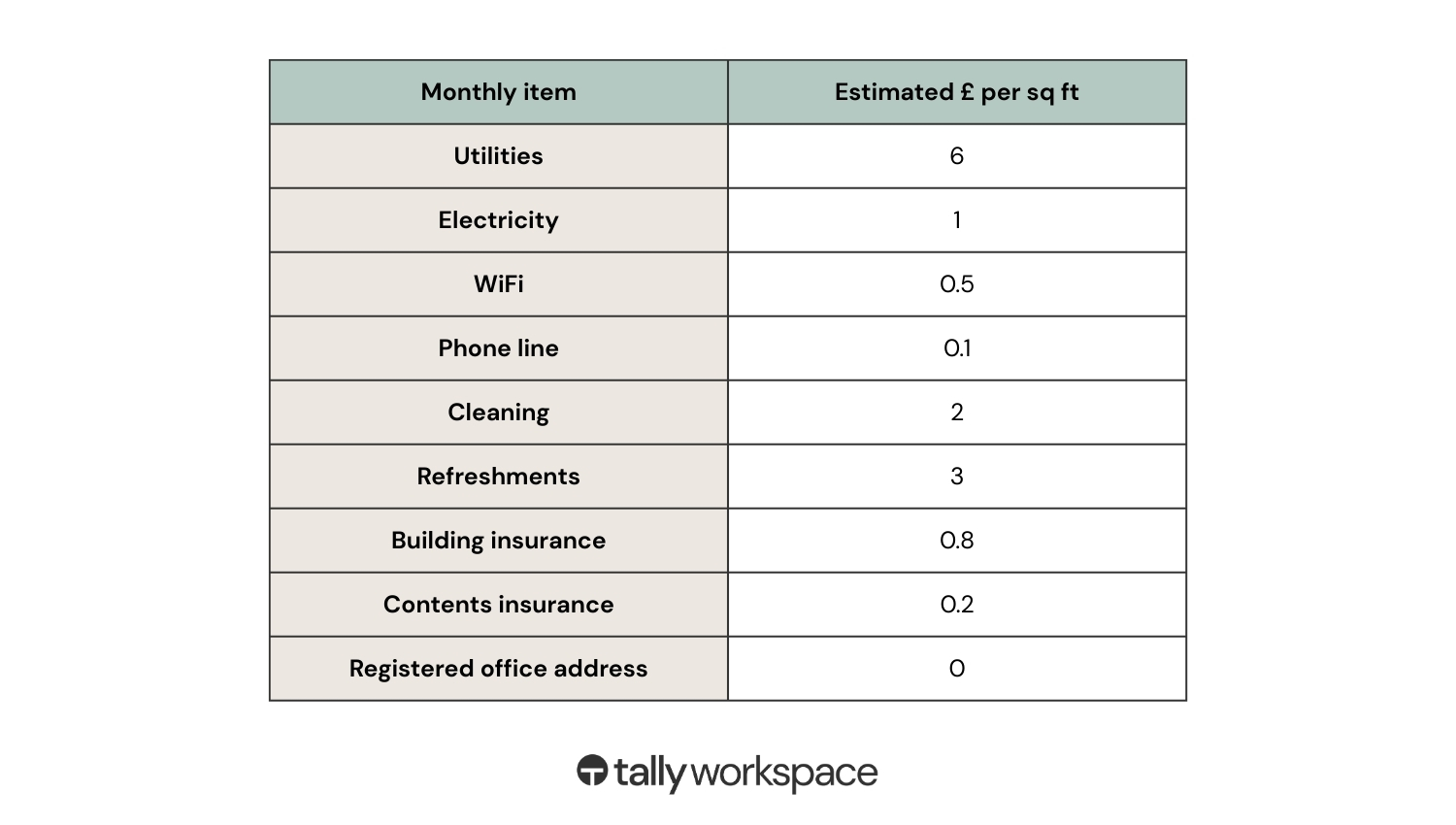
Tenants take on a range of operational costs, which vary depending on how you choose to run the space:
These costs add up, but they also give you flexibility. You set the standard for cleanliness, internet speed, office culture, and refreshments — the details that shape people’s experience of the workplace.
One-off costs to budget for
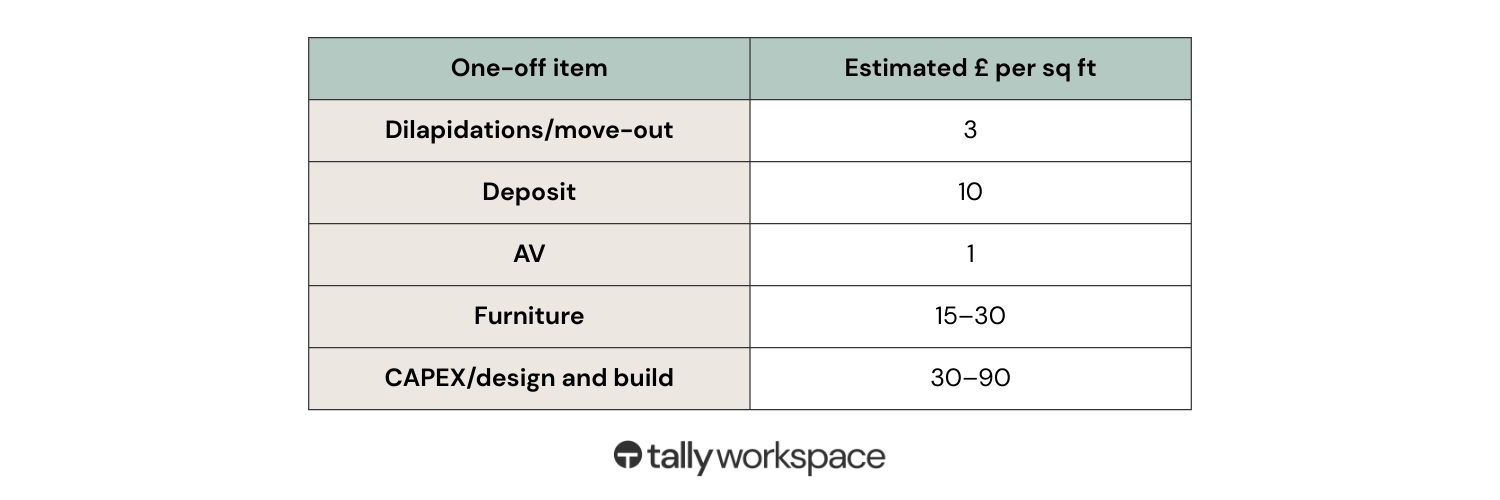
One-off costs are often underestimated, especially by first-time tenants.
Fit-out is usually the biggest investment. If the space is Cat A (an empty shell with ceilings, lighting, and basic services), you’ll need to fund everything else. If you choose a Cat A+ or second-hand fitted space, costs can be much lower and timelines much quicker.
What about managed leased offices?
Every leased space can come with a management layer if you want it. Management companies charge a monthly fee to oversee the operational side of the office, including:
Cleaning
Utilities
Wifi
Refreshments
Maintenance
Plant care
Supplier coordination
This suits teams that want the control and long-term stability of a lease but don’t want to run the building themselves.
A quick rule of thumb when estimating managed lease costs: Double the rent.
For example:
Rent: £50 per sq ft
All-in cost (rent, rates, service charge, management): £100 per sq ft
1,000 sq ft space = £100,000 per year, or £8,333 per month
Managed leased offices bridge the gap between serviced and leased environments, giving you autonomy without the admin.
How much space will you need in your traditional leased office?
Occupational density helps you estimate how much square footage your team needs. A realistic starting point is 1 person per 75 sq ft, which means a 10-person team usually requires around 750 sq ft. You’ll need additional space if you want meeting rooms, quiet pods, or collaboration areas. This calculation makes it easier to identify suitable buildings and avoid choosing a space that restricts future growth.
Leased office timelines are longer than people expect. Moving too quickly removes leverage during negotiations and limits your choice of buildings.
A realistic timeline is 3–9 months, depending on fit-out:
Requirements and planning (weeks 1–4): Understanding headcount, layout, budget, location, and growth plans.
Search stage (months 1–3): Scoping buildings, arranging tours, and comparing options. Having multiple options increases negotiation strength.
Heads of terms negotiation (1–2 months): Drafts go back and forth between solicitors. This stage can feel slow, but it's worth taking your time.
Legal and contract stage (2–3 months): Final negotiations, landlord approvals, licences to alter (if required).
Fit-out and move-in (1–3 months): Depends on whether you’re taking a fitted or unfitted space.
Allowing enough time gives you higher-quality options and better financial terms.
What landlords expect from traditional leased office tenants
There are a few criteria that help determine whether a business is ready for a traditional leased office, and understanding these early makes the entire process smoother.
Your business should be ready to commit
Traditional leases usually start at a minimum term of 3 years. If you want some flexibility within that, you can request a break clause, such as a 5-year lease with the option to break at year 3. This gives you stability while still allowing room for change.
Deposit requirements
Landlords typically expect a deposit, and the amount depends on your company’s financial position. Profitable businesses tend to pay around 3 months’ rent as a deposit, while pre-profit or early-stage companies may need to provide up to 12 months. The larger deposit can be clawed back gradually as the business demonstrates financial stability.
Realistic budget
This varies depending on what your budget includes.
Rent only: Minimum £50 per sq ft.
Rent, rates, service charge: Minimum £75 per sq ft.
All-inclusive (managed): Minimum £100 per sq ft.
Per-person budgets also matter. As a guide, £600 per person per month is the lowest feasible level for a leased office.
Clear requirements
Before any search, the following should be defined:
With this information, you can build a strong brief and avoid surprises later in the process.
How to compare traditional lease costs
Different platforms show pricing in very different ways, which can make an office search feel more complicated than it needs to be. Rightmove tends to show rent only, usually as a single monthly figure for the whole unit. Agency websites like Compton or Susskind go a step further by breaking out the rent, rates, and service charge, often listed per square foot per year.
But Tally Workspace takes a more transparent approach. We show the estimated monthly cost that already includes rent, rates, and service charge in one clear figure. It gives you a realistic snapshot of what you’ll actually pay each month, so you can compare spaces with confidence and avoid any surprises later on.
What is included in Heads of Terms?
Heads of Terms (HoTs) set out the main commercial points before solicitors draft the lease, making sure both parties are aligned on the fundamentals. Once HoTs are signed, the building usually goes under offer and the legal work begins. Solicitors start drafting the lease, due diligence and surveys get underway, and your fit-out designs move forward in parallel. Any remaining wording is negotiated until both sides are satisfied. After that, the lease is agreed, signed, and dated, and you receive the keys so your fit-out can begin.
HoTs also outline the fees due. In a traditional leased deal, the landlord covers the broker fee, which is typically equivalent to one month of rent.
A leased office works best for organisations that:
Want stability for at least 3 years
Have a clear budget and strong financials
Have predictable headcount/space needs
Want to customise their environment
Prefer a long-term home rather than short-term flexibility
If you’re unsure whether you’re ready, a quick requirements call often reveals the right next step. Some teams discover they need flexibility, while others realise a leased office gives them the stability they’ve been searching for.
A traditional lease gives you long-term stability, full creative control, and a dedicated space that reflects your team’s identity. It requires planning, budget clarity, and time — but for many organisations, it creates the kind of workplace where people feel grounded and ready to do their best work.
If you want support navigating the leasing process, comparing costs, or understanding what’s realistic for your team, Tally can guide you through every stage. We’ll help you find your perfect leased office and make your office move feel easy from start to finish.
Explore office space in London
Priority neighbourhoods with deep coverage across the city.
Senior Advisor - Commercial Real Estate, Tally Workspace
With 9 years in the commercial real estate industry, Harry Hopson is a seasoned expert in office leasing, tenant representation, and workplace strategy. As a Senior Advisor at Tally Workspace, Harry brings a wealth of experience from across the property sector, having worked with landlords, occupiers, and businesses ranging in size from start ups to multinational conglomerates.
From first office to scale-up headquarters, we have been there.
Secured a 14,000 sq ft CAT A leased HQ at White City Place
Introduced to 3 specialist fit-out partners, including Thirdway
Full market review spanning White City, Hammersmith & Soho
"Much like Butternut Box's brand, the project intent has been to pair a deeply human playfulness with elevated, premium design. Together we've crafted a joyful space which can bring out the best in all users, whether they be two or four legged."
"Tally helped us find our new office at lightning speed. Jules, Laura, and the team are the best at what they do. We wanted a rooftop, natural light, a central location, and a good deal. They got us 10+ solid options within 48hrs and scheduled all the viewings. We found our new space within 2 weeks."
Full market review across serviced, managed and leased office options
Custom layout designed by a workspace specialist - at no extra cost
Secured a self-contained 1,850 sq ft space in Leicester Square
"Tally Workspace exhausted the market and found us just what we were looking for within weeks. They were a breath of fresh air, extremely knowledgeable and helpful, and even assisted with design and fit-out. Very proactive at every stage, like an extension of our own team."
Secured a 2,000 sq ft self-contained HQ in Shoreditch
Workspace designer sourced and managed as part of the service
Used Tally Workspace on-demand between offices
"Tally Workspace has been an incredible help for Sifted. From understanding the office/remote first landscape to finding the right office for all of our requirements."
Shortlisted options across Marylebone, Victoria, Waterloo & Holborn
Secured a 60-desk office with internal meeting rooms in TCR
"You made this whole project smooth and actually enjoyable. You're well connected, which opened up options we wouldn't have found ourselves. I'm confident we would have missed this fantastic opportunity without your help, and you secured us a much better price than we could have achieved directly."
"I'd say it is a no brainer! A win win to use Tally Workspace to find your next space. No additional cost but endless extra value."
Founder & Lightning
"Not only are they very knowledgeable about the market, but they're lovely people to deal with. We're so happy with our final choice and can't wait to move!"
Finance Unlocked
"The space they found was perfect for our team, with loads of amazing breakout space, beautiful meeting rooms and a real emphasis on wellbeing."
Florence
"They got us 10+ solid options within 48hrs and scheduled all the viewings. Highly recommend. We found our new space within 2 weeks."
Cryptio
How Tally Workspace works
Tell us what you need
Team size, budget, location, and deal breakers. We'll ask about the things most people forget too.
searching...
We handle the search
We search our proprietary database then call landlords directly about unlisted spaces. Often back to you within a day.
We handle the detail
Contracts are where most searches fall apart. We review everything and negotiate before you sign.
You move in confident
Best space, best terms, timeline that fits your growth. You know exactly what you're signing.
Tell us what you're looking for
Find an office today
Using our extensive mapping of startup and scaleup office space, find an office that fits your needs and your culture in just a few minutes.