Business rates are a significant ongoing cost for UK businesses occupying non-domestic properties.
Business rates are calculated based on the property's rateable value and an annual government multiplier.
Changes in business rates are expected in 2026, affecting various sectors and property values.
Business rates are a tax on most non-domestic properties, including offices. They’re part of the cost of your workspace, alongside rent and service charges. There’s no VAT on a business rates bill paid directly to the council.
This guide covers England from 1 April 2026 to 31 March 2027. Scotland, Wales and Northern Ireland have different rules, which we touch on near the end.
This article explains how to calculate your bill, what changed in April and which reliefs reduce the cost. If you’re comparing office space in London, it also covers rates included in serviced office fees.
What are business rates in the UK?
Business rates are the commercial equivalent of council tax. Council tax applies to homes; business rates apply to offices and other business premises. You’ll also see them called non-domestic rates. Both are collected by the local council.
For an occupied property, the business in occupation is responsible for the rates. If the property is empty, responsibility falls to whoever is entitled to occupy it. That might be the landlord or a tenant whose lease is still running. If your business is legally responsible for the bill, a landlord’s agreement to pay it does not remove that responsibility.
Some small offices have no business rates bill. An eligible business using just one property gets 100% small business rate relief if its rateable value is £12,000 or less. We explain the thresholds in the reliefs section below.
Is there VAT on business rates?
No. Councils do not charge VAT on business rates. If you pay your bill directly to the council, there’s no VAT to add or reclaim.
The position is different when rates are included in a landlord’s or serviced office provider’s charge. If the provider is responsible for the rates and passes that cost on through your rent or office fee, it follows the VAT treatment of that charge. If the fee includes VAT, the rates element does too.
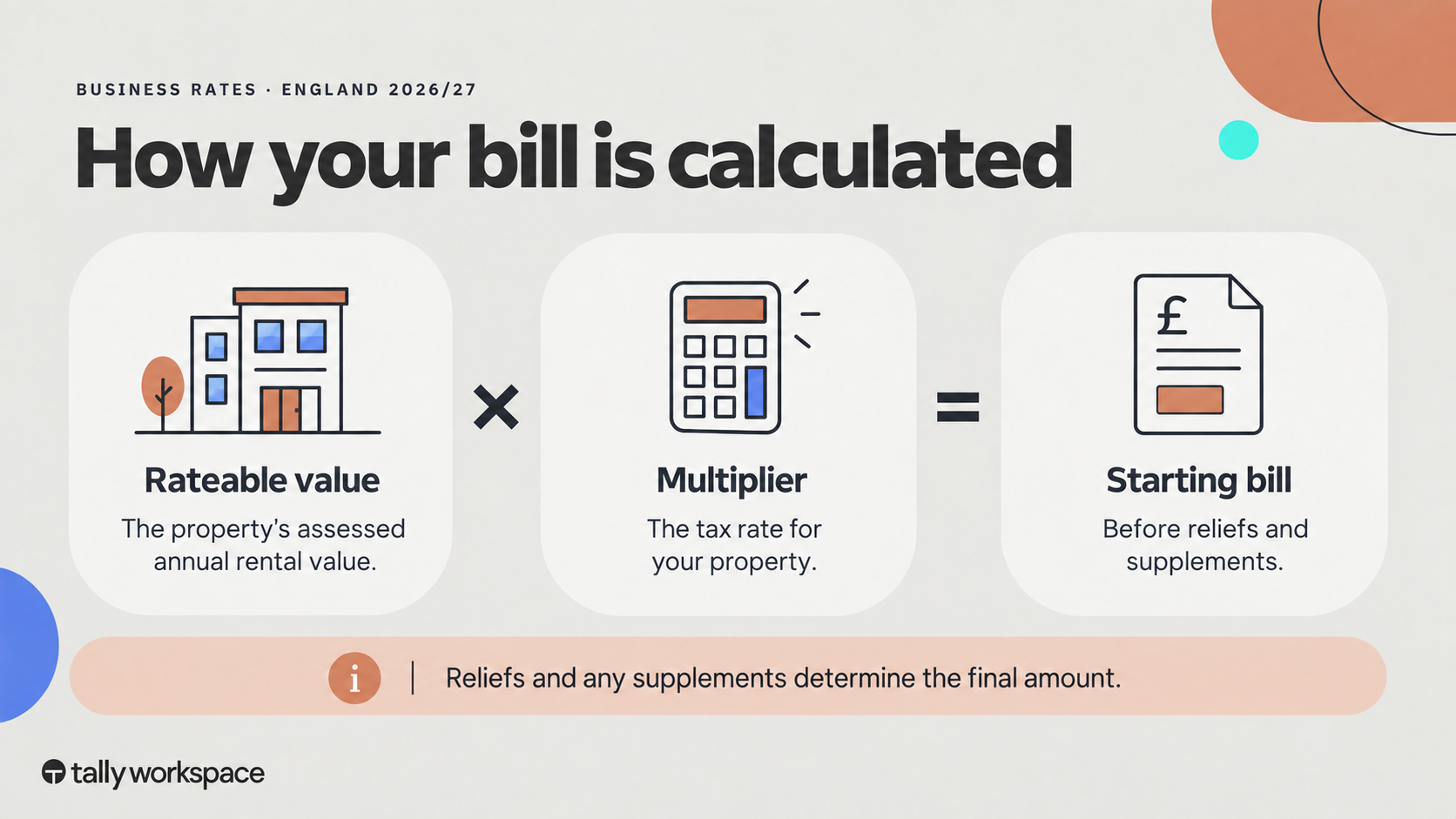
The rateable value is the Valuation Office’s estimate of the property’s annual rental value at a set date. It is not necessarily the rent you pay. The council multiplies it by the government’s tax rate for that year, called the multiplier, to work out the starting bill.
Starting bill = rateable value × multiplier. Reliefs and any supplements determine the final amount.
A worked example: Take an office with a rateable value of £40,000. It falls in the lowest band, so the starting bill is £40,000 × 43.2p = £17,280 a year.
If it’s an existing property receiving neither transitional relief nor Supporting Small Business Relief, the temporary 1p supplement adds £400. That brings the bill to £17,680 before any other relief. The office is below the Crossrail threshold, and there’s no City premium if it’s outside the City of London.
Extra charges in 2026/27
Temporary 1p supplement. In 2026/27, existing properties receiving neither transitional relief nor Supporting Small Business Relief pay an extra £10 for every £1,000 of rateable value.
New properties added to the rating list from 1 April 2026 are excluded, except those created by splitting or merging an existing assessment. The rules are set out in Letter 5/2025, with a summary from Bristol City Council.
Crossrail Business Rate Supplement. London properties with a rateable value above £92,000 pay an extra 2p for every £1 of their whole rateable value. The threshold was £75,000 last year. Reliefs apply at the same percentage as on the main bill, but transitional relief does not apply to this supplement. Kensington and Chelsea Council’s guidance explains the calculation.
City of London premium. An office in the Square Mile pays an extra 2.9p if it falls in the small-business band, or 3.2p in the other bands. This is separate from the temporary 1p supplement. The City of London Corporation’s billing guidance sets out the charges.
Include any supplements when comparing office costs. Use the current valuation and the reliefs your business qualifies for; don’t assume the previous occupier’s discount will apply to you.
What changed in April 2026?
The April 2026 revaluation updated rateable values to reflect rents at 1 April 2024. The government also changed the multipliers and introduced a higher band for properties valued at £500,000 or more. Both affect the bill, so a higher valuation does not automatically mean higher rates.
Will my business rates go up in 2026?
For offices that stayed in the £51,000 to £499,999 band, the multiplier fell from 55.5p in 2025/26 to 48p in 2026/27. It is 49p once the temporary 1p supplement is added, where that applies.
Here’s what that means for an existing Southwark office previously valued at £60,000. These examples assume no relief in either year and that the 1p supplement applies in 2026/27:
Both examples are below the Crossrail threshold and outside the City of London, so neither local charge applies. Under these assumptions, the valuation would need to rise by about 13.3% for the bill to stay the same: £33,300 ÷ £0.49 = roughly £67,959. This is our calculation using the published multipliers.
The outcome is different if an office moves into a higher multiplier band or loses relief. Transitional relief and Supporting Small Business Relief limit qualifying increases, as explained below.
Which properties are business rates charged on?
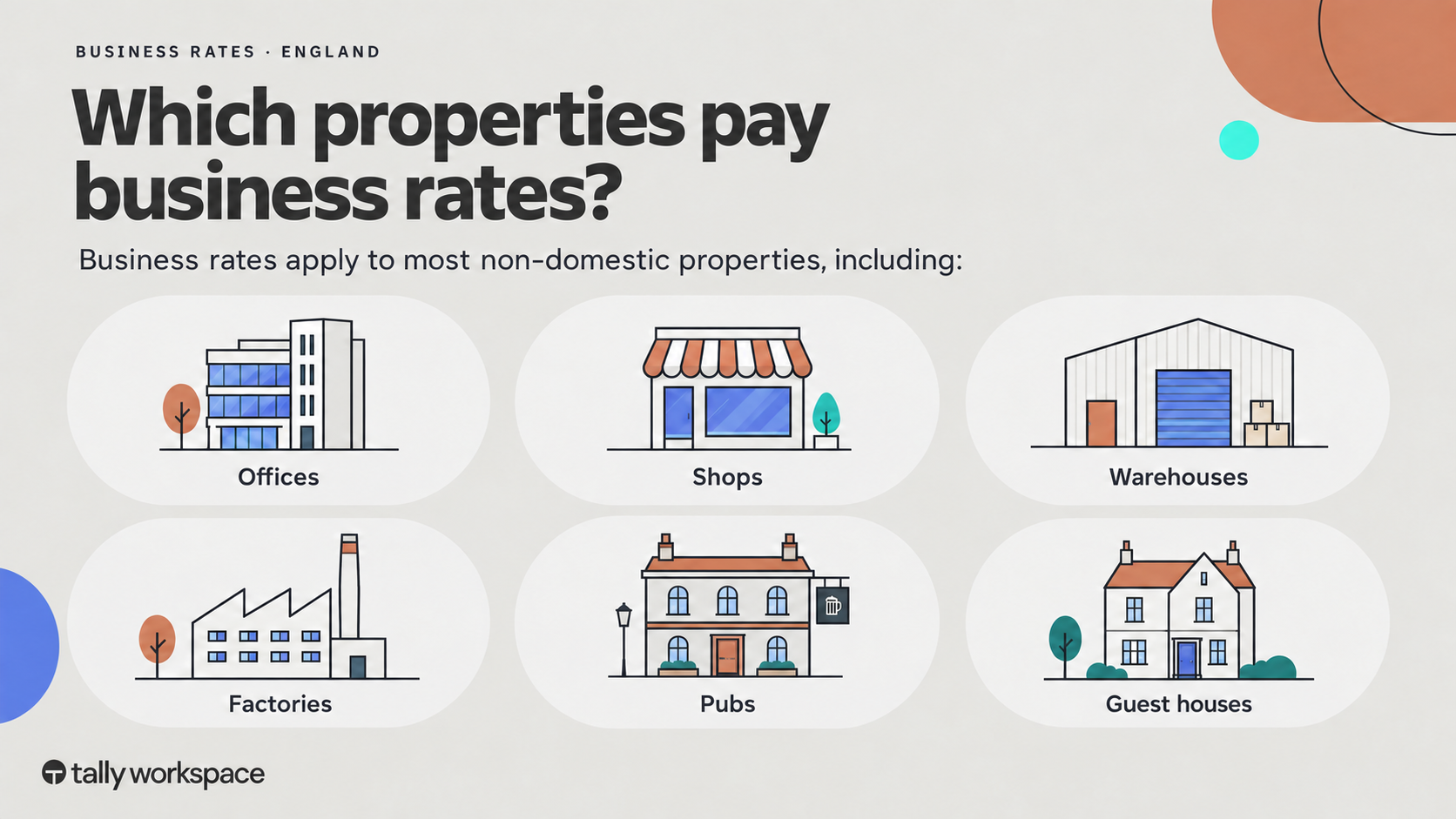
Business rates apply to most non-domestic properties used for business purposes, including:
Business rates apply to most non-domestic properties, including offices, shops, warehouses, factories, pubs and guest houses.
Are business rates and council tax the same?
They're similar in structure, but they're separate taxes that apply to different types of property. Council tax is charged on domestic properties — where people live. Business rates are charged on non-domestic properties — where people work, trade, or operate. Both are collected by local authorities and used to fund local services, but the rates, calculations, and reliefs are entirely different. So if you run a business from a commercial premises, you'll pay business rates. If you live above the shop, you'll pay council tax on the residential part separately.
Are business rates subject to VAT?
No. Business rates fall outside the scope of UK VAT, which means you won't be charged VAT on your bill and you can't reclaim VAT on them either. This is worth bearing in mind when you're budgeting, as business rates are a straight cost with no VAT offset available.
Are business rates paid monthly?
By default, your local council will split your annual bill into 10 monthly instalments, running from April to January — leaving February and March payment-free. But if you'd prefer to spread the cost more evenly across the year, you can request 12 monthly instalments from your local authority instead. It's a small change, but it can make cash flow forecasting a little more straightforward — particularly useful if you're an early-stage business keeping a close eye on monthly outgoings.
Do I have to pay business rates in the UK?
The short answer: if your business occupies a non-domestic property in the UK, yes — you'll almost certainly need to pay business rates.
The occupier is responsible for payment, not the landlord. Even if your landlord has agreed to cover business rates as part of your lease, the bill is legally in your name. If it goes unpaid, the local authority will come to you, not them. Always double-check what's included in your lease before signing.
There are a couple of scenarios where business rates work a little differently:
Serviced or all-inclusive offices: If you're in a fully serviced office space on a managed contract, business rates are typically bundled into your monthly fee. No separate bill to worry about.
Conventional office leases: Business rates are charged on top of rent. This is worth factoring into your total cost of occupation when comparing office spaces — at Tally, we use a cost comparison table to make sure you can see exactly what's included and what isn't.
Empty properties: Business rates are still payable on vacant commercial properties. You get a 3-month grace period rate-free, but after that, full rates apply. If your property becomes empty, you need to notify your local council.
What if I work from home?
Whether you need to pay business rates on your home depends on how you use it. If you occasionally check emails from the sofa or take the odd call from your kitchen table, you're almost certainly fine — HMRC doesn't consider that business use.
But if part of your home is used exclusively for business purposes (a dedicated studio, a room that's set up solely as an office, or a space where clients regularly visit), the Valuation Office Agency may assess that part of your property for business rates. In that scenario, you could end up paying both council tax and business rates — on the same property. If you're in any doubt, it's worth speaking to your local council before you find yourself with an unexpected bill.
How do business rates differ across England, Scotland, Wales and Northern Ireland?
Business rates are a devolved matter, which means the rules aren't identical across all 4 nations.
In Scotland, business rates are administered by local councils but the multiplier is set by the Scottish Government — and Scotland has its own version of small business relief, called the Small Business Bonus Scheme, which is generally more generous than the equivalent in England.
In Wales, the Welsh Government sets the multiplier and manages its own relief schemes, including a Small Business Rates Relief scheme with different thresholds.
Northern Ireland operates a different system entirely — instead of rateable values based on rental estimates, Northern Ireland uses capital values to calculate rates, and bills are split between a regional rate and a district rate.
So if your business operates across multiple nations, or you're weighing up office locations in different parts of the UK, it's worth checking the specific rules for each region rather than assuming the same figures apply everywhere.
What is happening to business rates in 2026?
2026 is a significant year for business rates in England. The government has introduced a series of changes that will affect how much businesses pay — particularly in the retail, hospitality, and leisure sectors, and for properties in high-value areas.
Here's what's changed:
New multipliers from April 2026. The government has introduced updated multipliers for the 2025–26 financial year. For properties with a rateable value below £51,000, the small business multiplier is 49.9 pence. For properties above £51,000, the standard multiplier is 55.5 pence — a notable increase from previous years.
Retail, hospitality and leisure (RHL) relief reduced. The RHL relief — which had been providing significant discounts for businesses in these sectors — has been reduced from 75% to 40% from April 2025 onwards, with a cap of £110,000 per business. If your business falls into this category, your bill will be higher than it was last year.
Transitional relief continues. The government's transitional relief scheme is still in place to soften the impact of large rate increases year on year. It phases in bill changes gradually, so you shouldn't see a dramatic spike overnight.
Long-term reform plans. The government has committed to wider business rates reform over the coming years, with a focus on making the system fairer for high street businesses and reducing the burden on smaller operators. Revaluations are now set to happen every 3 years rather than every 5, with the next revaluation due in 2026.
If you're in the process of choosing office space, these changes are worth factoring into your budget. Our office space calculator can help you estimate the right size of space for your team — because the size and layout of your office directly affects your rateable value.
How are business rates worked out in the UK?
Business rates are calculated using a straightforward formula:
Rateable value × multiplier − any reliefs or deductions = business rates payable
Let's break that down.
What is rateable value?
The rateable value is an estimate of what your property could be rented for on the open market on a specific date. It's set by the Valuation Office Agency (VOA) and takes into account the property's size, location, and condition.
Rateable values are reviewed periodically through revaluations. The most recent revaluation came into effect on 1 April 2023, based on market values from 1 April 2021. The next revaluation is due in 2026.
What is the multiplier?
The multiplier is the figure the government sets each year, expressed in pence per pound of rateable value. For 2025–26:
Properties with a rateable value below £51,000: 49.9 pence
Properties with a rateable value above £51,000: 55.5 pence
Step-by-step: How to calculate your business rates
Step 2. Identify the correct multiplier for your property's rateable value.
Step 3. Multiply the rateable value by the multiplier.
Step 4. Deduct any business rate reliefs you're eligible for.
Rateable value multiplied by the multiplier gives the starting bill. Reliefs and supplements determine the final amount.
Example calculation for 2025–26
Sally’s office has a rateable value of £60,000. Because this is above £51,000, the standard multiplier of 55.5 pence applies.
Rateable value: £60,000
Multiplier: £0.555
Business rates before relief: £60,000 × £0.555 = £33,300
Sally has no applicable reliefs, so £33,300 is payable for the year
When do you pay business rates?
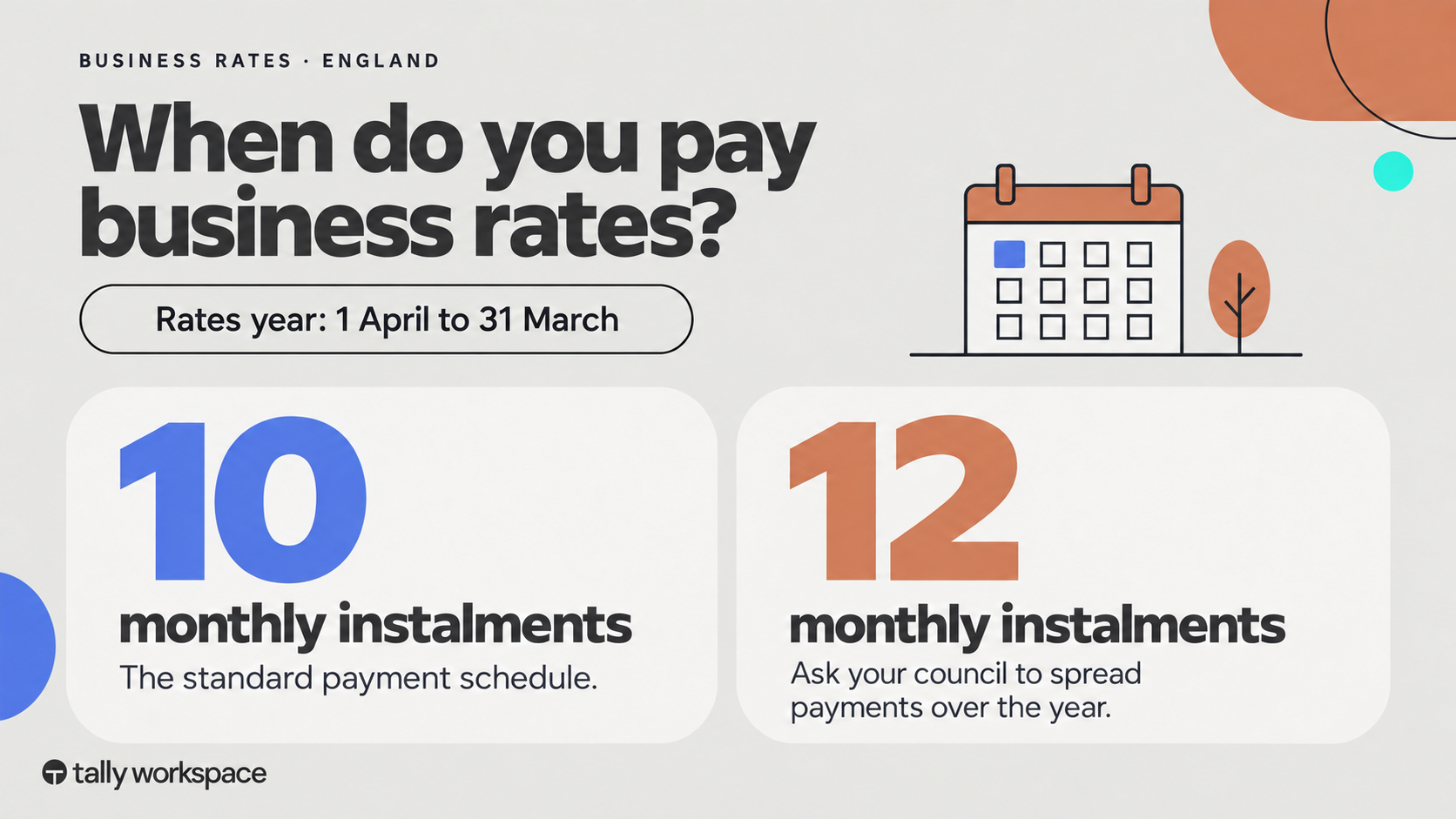
Local councils send out business rates bills in February or March each year, covering the following tax year. Payment runs on a 10-month cycle by default, but you can request 12 monthly instalments from your local authority — which can make budgeting a bit easier.
The business rates year runs from 1 April to 31 March, with 10 monthly instalments as standard or 12 on request.
What business rate reliefs are available?
There are several reliefs available that could reduce — or even eliminate — your business rates bill. Here are the main ones:
Small business rate relief
If your property has a rateable value below £12,000 and you only use 1 property, you pay no business rates at all. If your rateable value falls between £12,000 and £15,000, you'll get a sliding scale of relief. Above £15,000, full rates apply — but other reliefs may still be available.
Retail, hospitality and leisure relief
As noted above, this relief has been reduced to 40% from April 2025, with a cap of £110,000 per business. If you're in retail, hospitality or leisure, it's still worth claiming — it just covers less than it did previously.
Enterprise Zone relief
Businesses in designated Enterprise Zones can receive business rate discounts of up to £55,000 per year for up to 5 years (up to £275,000 in total). There are 48 Enterprise Zones across the UK covering a range of sectors and regions. Worth checking if your location qualifies.
Transitional relief
This limits how much your bill can increase in a single year following a revaluation. It's applied automatically, so you don't need to apply.
Charitable rate relief
Charities using a property for charitable purposes can apply for up to 80% relief. Non-profit organisations may also be eligible for discretionary relief — contact your local council to find out.
The full list is on HMRC's business rates relief page. If you're unsure what you're eligible for, your local council is the best starting point.
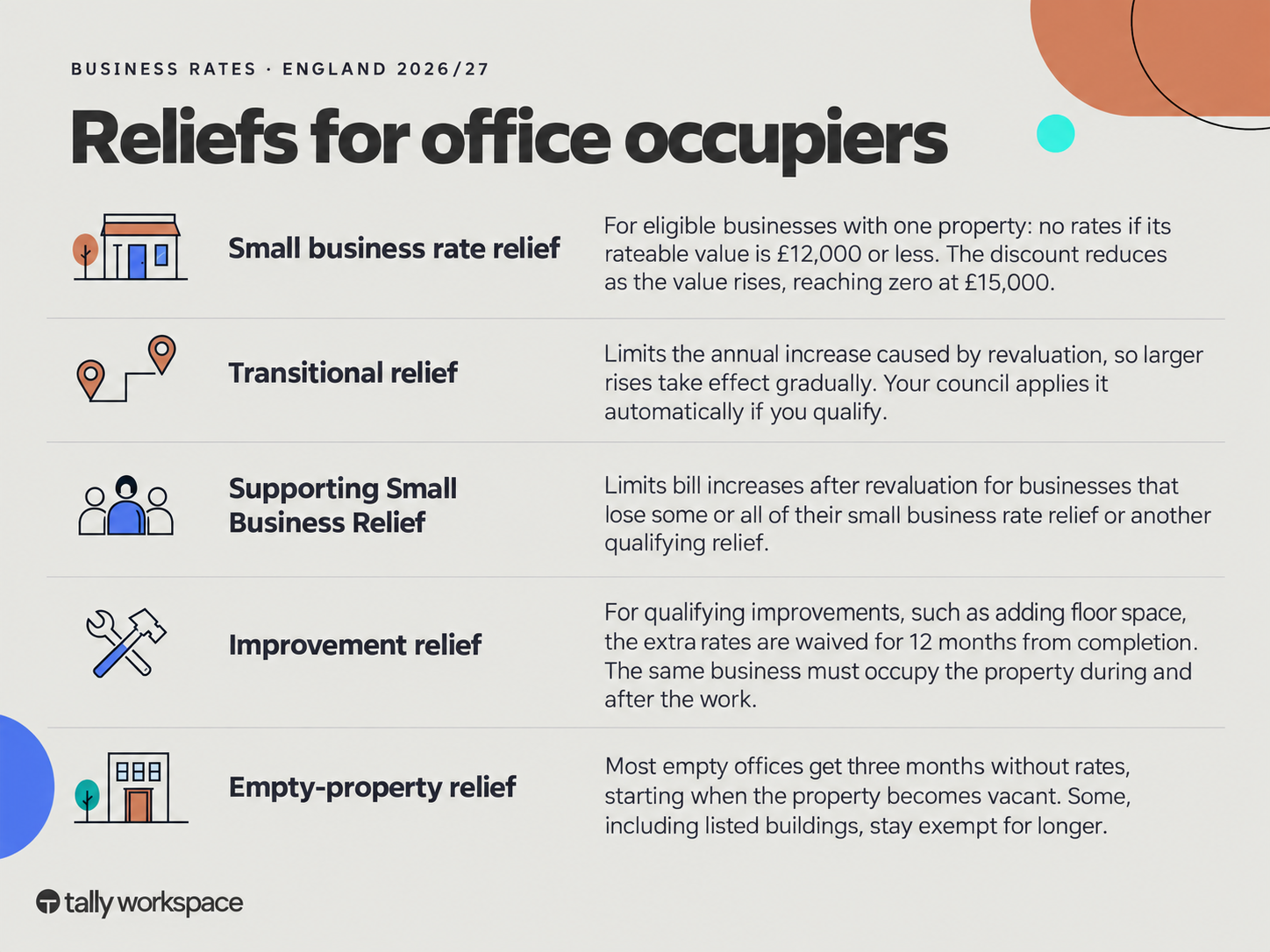
Office reliefs include small business rate relief, transitional relief, Supporting Small Business Relief, improvement relief and empty-property relief.
Can I get business rates relief if I've just moved into a property?
Moving into a new commercial property doesn't automatically trigger any special relief — but it does make it the right moment to review what you're eligible for. As soon as you move in, you become liable for business rates from day one, so it's worth contacting your local council promptly to register as the new occupier and get your bill set up correctly.
From there, the reliefs available to you are the same as for any other occupier — small business rate relief, retail hospitality and leisure relief, Enterprise Zone relief, and so on. What changes is the urgency: if you're moving into a property for the first time, you might not yet know what your rateable value is, whether it's accurate, or whether you qualify for relief. That's worth sorting out early.
If you think the rateable value has been set incorrectly — perhaps it reflects a previous tenant's use of the space, or the property has changed significantly — you can challenge it through the VOA's Check, Challenge, Appeal process. Getting this right at the start of your tenancy is much easier than trying to reclaim overpaid rates further down the line.
Can I appeal my business rates?
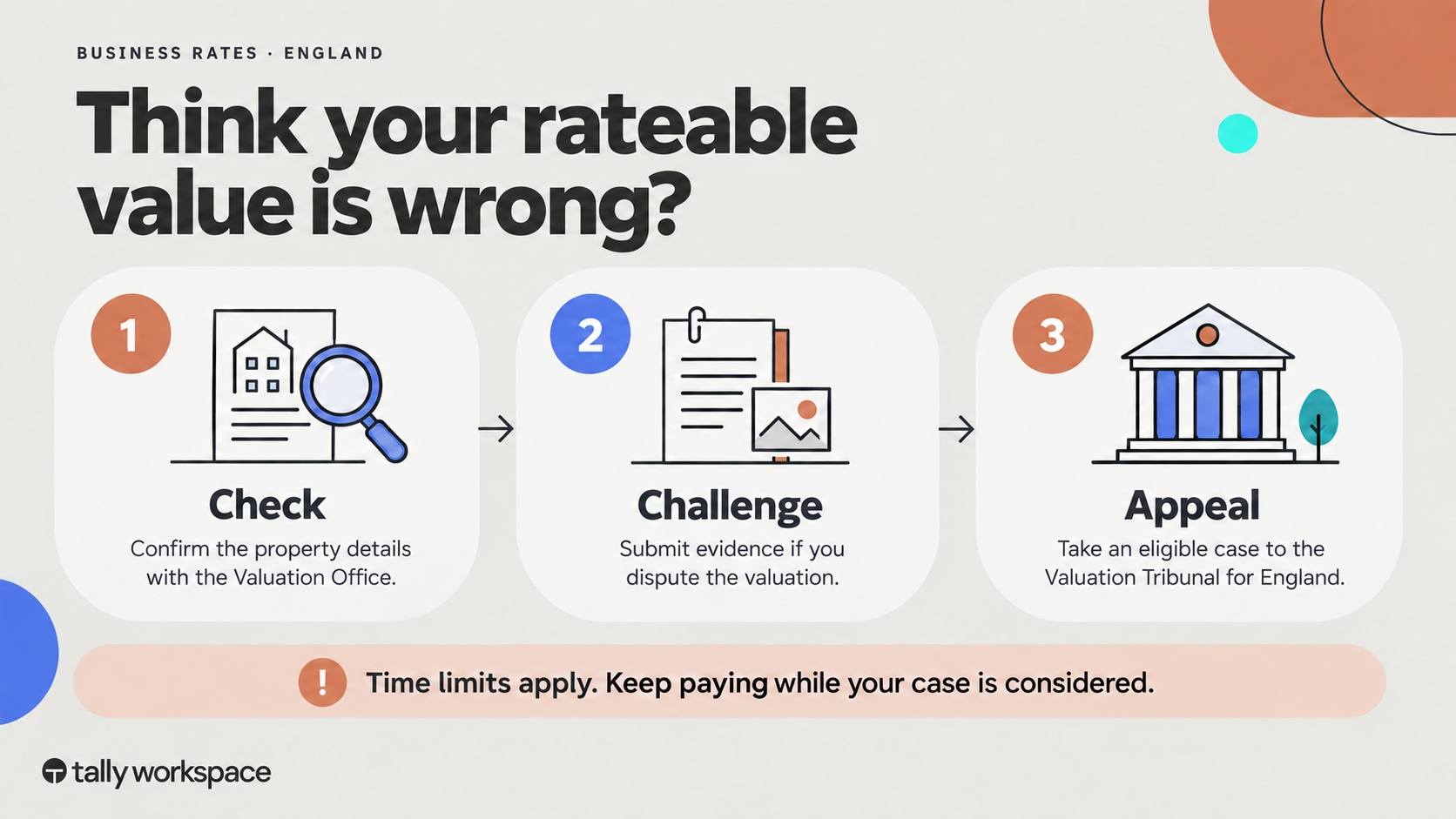
Yes. If you think your rateable value is wrong, you can challenge it through the VOA's Check, Challenge, Appeal process.
Start by gathering evidence — rental values for comparable properties nearby, recent sales data, or anything that supports a lower valuation. Submit your challenge to the VOA, and if you're not satisfied with the outcome, you can escalate to a formal appeal.
Check property details with the Valuation Office, challenge the valuation with evidence, then appeal to the Valuation Tribunal for England if eligible.
Are business rates payable on vacant office space?
Business rates are normally payable even if a property is unoccupied.
For the first 3 months, you don't have to pay business rates, but after this period, most businesses pay full business rates.It is your responsibility to contact your local council and notify them if your property is vacant.
What happens if I don't pay my business rates?
Missing a business rates payment isn't something to ignore. Local councils take non-payment seriously, and the process escalates fairly quickly. If you miss an instalment, your council will send a reminder notice giving you 7 days to pay. Miss that deadline, and you lose the right to pay in instalments — the full outstanding balance for the year becomes due immediately.
If that remains unpaid, the council can apply to a magistrates' court for a liability order, which gives them the legal authority to recover the debt. From there, they can instruct enforcement agents (bailiffs) to seize business assets, deduct money directly from your income if you're a sole trader, or — in the most serious cases — pursue bankruptcy or winding-up proceedings.
The important thing to know is that there's usually a way through if you're proactive. If you're struggling to pay, contact your local council before you miss a payment, not after. Most councils have hardship relief available for businesses in genuine financial difficulty, and many will work with you on a payment arrangement rather than go straight to enforcement. The worst thing you can do is ignore the bill and hope it goes away. It won't, and the consequences get significantly more serious the longer it's left.
Where should I go for advice on business rates?
You do not need a representative to dispute your rateable value or bill.
However, if you're seeking advice members of the Royal Institution of Chartered Surveyors (RICS) are a good place to start as they are qualified in the area.Navigating the complexities of UK business rates can feel overwhelming, especially when you're focused on steering your business toward success.But with the right knowledge and tools at your disposal, you can make informed decisions that help you manage your office space costs effectively.Whether you're just starting out or managing a large portfolio, understanding how business rates impact your budget is crucial.
At Tally Workspace, we're here to simplify this process for you. From cost comparison tables to expert advice, we ensure you have all the information you need to choose the best office space for your business — without any hidden surprises.
Getting business rates right from the start
Choosing the right office space affects more than just your rent. The size, location, and type of space directly influences your rateable value — and therefore your business rates bill.
At Tally Workspace, we help startups and scale-ups find office spaces that work for their teams and their budgets. That means being upfront about all costs, including business rates, so there are no surprises further down the line.
Can I be charged business rates and council tax on the same property?
Yes — and it's more common than you might think. If you run a business from a property that's also your home, the VOA may decide that part of it should be assessed for business rates while the rest remains subject to council tax. This typically happens when a part of the property is used exclusively for business purposes — a ground-floor consulting room, a studio with a separate entrance, or a space where clients regularly visit. In that situation, your council tax bill may also be reduced to reflect the fact that part of the property is no longer classed as domestic. The key word is "exclusively" — occasional or incidental business use generally won't trigger a split assessment. If you're unsure how your property is classified, the VOA can advise.
Do I pay business rates if I rent a desk in a coworking space?
No. If you're renting a hot desk, a dedicated desk, or even a private office within a managed coworking space, business rates are the responsibility of the space operator — not you. It's one of the less obvious financial advantages of flexible working arrangements. The operator pays business rates on the building as a whole and factors that cost into their membership pricing, so it's already covered in what you pay each month. This is worth remembering when you're comparing the true cost of a coworking membership against a conventional office lease, where business rates would be an additional line on top of your rent.
Are business rates tax deductible?
Yes. Business rates are considered an allowable business expense, which means you can deduct them from your profits when calculating your Corporation Tax or Income Tax liability. Keep records of what you've paid, and make sure your accountant includes them in your annual accounts. If you receive a business rates relief that reduces your bill, only the amount you actually pay is deductible — not the original figure before relief. It's a relatively straightforward deduction, but it's one that's easy to overlook if you're not on top of your business expenses. If business rates are bundled into a single monthly payment as part of a serviced office contract, it's worth asking your provider for a breakdown so you can account for them correctly.
Can my rateable value go down as well as up after a revaluation?
Yes. A revaluation reflects changes in the property market since the last assessment date, and if rental values in your area have fallen — or if your property type has become less desirable — your rateable value could decrease. That said, revaluations don't automatically mean lower bills for everyone. In areas where commercial property values have risen, rateable values will increase, and bills will follow. The 2023 revaluation saw significant increases for properties in high-demand locations, particularly in Central London. If you think your new rateable value doesn't accurately reflect your property's market rental value, you can challenge it through the VOA's Check, Challenge, Appeal process — and a revaluation is often the prompt that makes it worth doing.
Do business rates change if I refurbish or extend my office?
They can. If you make significant changes to your property — extending the floorspace, adding a mezzanine level, or substantially improving the fit-out — the VOA may reassess the rateable value to reflect the property's new condition and market rental value. A higher rateable value means a higher business rates bill. Minor internal refurbishments are less likely to trigger a reassessment, but structural changes or extensions almost certainly will. It's worth factoring potential business rates increases into your budget before committing to significant works — especially if you're already close to a threshold that affects your eligibility for small business rate relief.
Are business rates payable on a listed building?
Yes. Being listed doesn't exempt a property from business rates. Listed buildings are assessed for rateable value in the same way as any other commercial property. However, the listed status of a building may be taken into account during the valuation process, since it can affect what a tenant would be willing to pay in rent — listed buildings often come with restrictions on how they can be used and altered, which can influence their market rental value. If you're taking on a listed building, it's also worth checking whether any other reliefs apply, such as charitable relief or hardship relief, depending on your situation. Your local council is the best first point of contact for advice specific to your property.
Written by Laura Beales
Co-Founder, Tally Workspace
Laura Beales is the Co-Founder of Tally Workspace, bringing a unique blend of financial expertise and real estate knowledge to the office space industry. A qualified Chartered Accountant, Laura began her career in finance but transitioned into commercial property after experiencing first-hand the inefficiencies and lack of transparency in the market from a customer perspective.
From first office to scale-up headquarters, we have been there.
Secured a 14,000 sq ft CAT A leased HQ at White City Place
Introduced to 3 specialist fit-out partners, including Thirdway
Full market review spanning White City, Hammersmith & Soho
"Much like Butternut Box's brand, the project intent has been to pair a deeply human playfulness with elevated, premium design. Together we've crafted a joyful space which can bring out the best in all users, whether they be two or four legged."
"Tally helped us find our new office at lightning speed. Jules, Laura, and the team are the best at what they do. We wanted a rooftop, natural light, a central location, and a good deal. They got us 10+ solid options within 48hrs and scheduled all the viewings. We found our new space within 2 weeks."
Full market review across serviced, managed and leased office options
Custom layout designed by a workspace specialist - at no extra cost
Secured a self-contained 1,850 sq ft space in Leicester Square
"Tally Workspace exhausted the market and found us just what we were looking for within weeks. They were a breath of fresh air, extremely knowledgeable and helpful, and even assisted with design and fit-out. Very proactive at every stage, like an extension of our own team."
Secured a 2,000 sq ft self-contained HQ in Shoreditch
Workspace designer sourced and managed as part of the service
Used Tally Workspace on-demand between offices
"Tally Workspace has been an incredible help for Sifted. From understanding the office/remote first landscape to finding the right office for all of our requirements."
Shortlisted options across Marylebone, Victoria, Waterloo & Holborn
Secured a 60-desk office with internal meeting rooms in TCR
"You made this whole project smooth and actually enjoyable. You're well connected, which opened up options we wouldn't have found ourselves. I'm confident we would have missed this fantastic opportunity without your help, and you secured us a much better price than we could have achieved directly."
"I'd say it is a no brainer! A win win to use Tally Workspace to find your next space. No additional cost but endless extra value."
Founder & Lightning
"Not only are they very knowledgeable about the market, but they're lovely people to deal with. We're so happy with our final choice and can't wait to move!"
Finance Unlocked
"The space they found was perfect for our team, with loads of amazing breakout space, beautiful meeting rooms and a real emphasis on wellbeing."
Florence
"They got us 10+ solid options within 48hrs and scheduled all the viewings. Highly recommend. We found our new space within 2 weeks."
Cryptio
How Tally Workspace works
Tell us what you need
Team size, budget, location, and deal breakers. We'll ask about the things most people forget too.
searching...
We handle the search
We search our proprietary database then call landlords directly about unlisted spaces. Often back to you within a day.
We handle the detail
Contracts are where most searches fall apart. We review everything and negotiate before you sign.
You move in confident
Best space, best terms, timeline that fits your growth. You know exactly what you're signing.
Tell us what you're looking for
Find an office today
Using our extensive mapping of startup and scaleup office space, find an office that fits your needs and your culture in just a few minutes.