A licence to alter is necessary for most office tenants making significant changes to leased premises.
Tenants typically pay for both their own and the landlord's professional fees.
The licence to alter should be integrated into the office relocation timeline.
Moving into a new leased office often means changing the space. more meeting rooms, different layouts, new air conditioning. In legal terms, those changes sit behind a document called a licence to alter. Understanding how that licence works will save you time, money and frustration.
Key points about licences to alter in commercial property
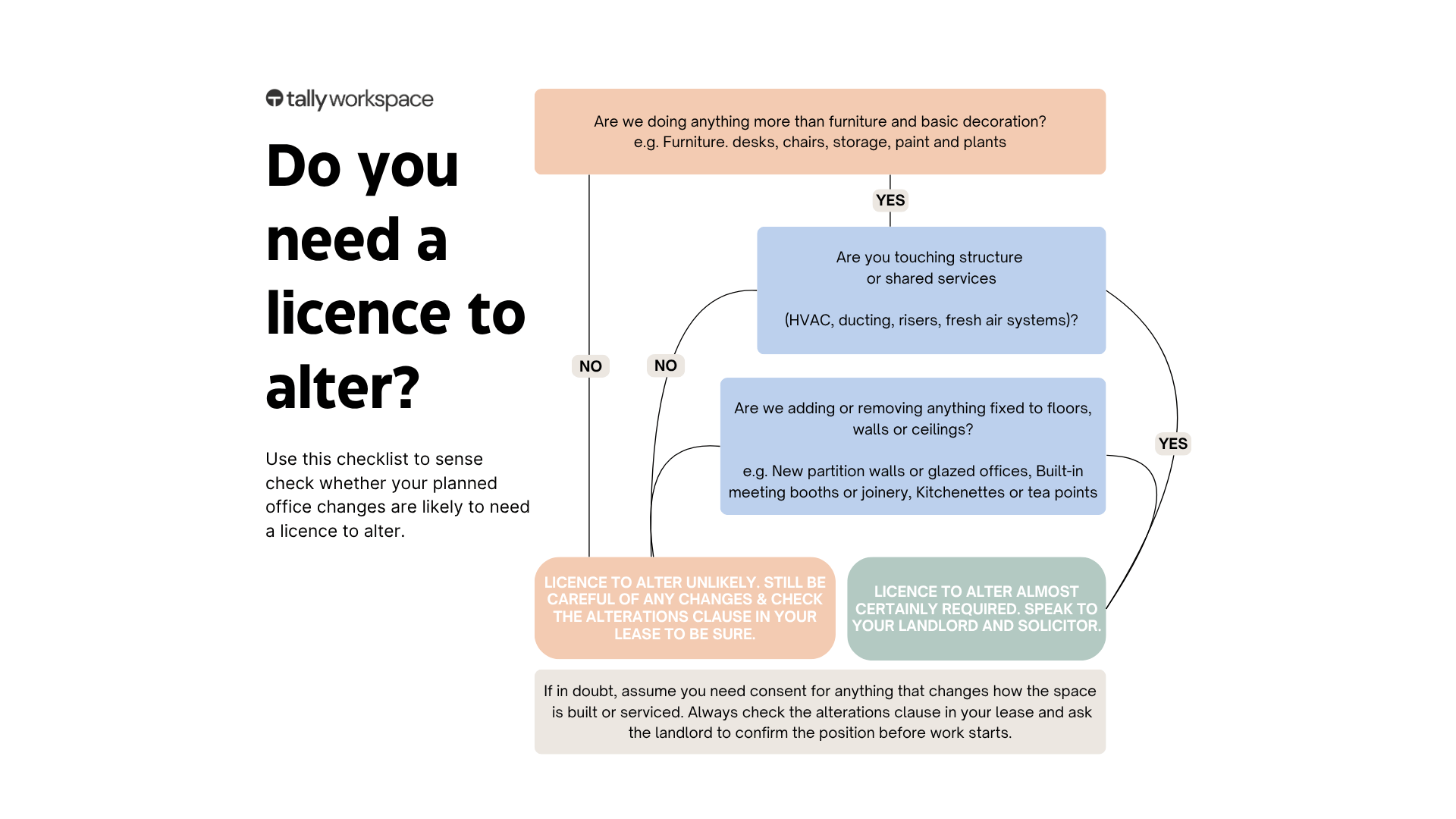
Most office tenants need a licence to alter if they move HVAC, ducting or other shared services.
A typical licence to alter for a standard CAT B fit out takes around 4 to 8 weeks.
Tenants usually pay both their own and the landlord’s professional fees.
Treat the licence as a core part of your office relocation timeline, not a bolt on at the end.
What is a licence to alter in commercial property
A licence to alter in commercial property is a formal written agreement in which a landlord gives a tenant permission to carry out specified alterations to leased premises, on set conditions. In most modern UK commercial leases, tenants are not allowed to make anything more than very basic changes without this formal consent, particularly where works affect the layout, structure or services of the building.
In practice, if your business wants to put in extra meeting rooms, move air conditioning, install new lighting or reconfigure an office layout, your lease will almost certainly say you cannot do that without landlord consent. That consent is documented in the licence to alter.
Flowchart showing how office tenants can decide if they need a license to alter in a commercial property based on the type of changes planned.
A licence to alter typically records:
Exactly what works are permitted
How those works must be carried out
Who pays for professional fees and reinstatement
What must happen to the alterations at lease end
Who is party to a licence to alter?
A licence to alter usually sits alongside the lease and involves the same core parties.
Landlord. the owner or head lessor of the building
Tenant. the business occupying the premises under the lease
Superior landlord or freeholder. sometimes included if there is a headlease above your lease
Guarantor. if there is a guarantor on the lease, they may also be named
The document does not replace the lease. It is an additional deed that records the landlord’s consent to a clearly defined package of works and the terms attached to that consent.
What does a licence to alter in commercial property cover?
Although wording varies, most licences to alter cover four main areas.
1. Scope of works
The licence attaches drawings, specifications and method statements that describe the works in detail.
Typical examples for offices include.
Creating or removing meeting rooms and private offices
Installing or relocating kitchenettes and tea points
Moving or adding air conditioning cassettes and associated ductwork
Changing lighting layouts, power and data points
New floor finishes, reception joinery or internal glazing
This level of detail matters. If you later decide to extend the scope, you will usually need further consent.
2. Conditions on how the works are done
Landlords use the licence to control the way works are delivered, in order to protect the building and other occupiers. Common conditions include.
Working only within agreed hours
Limits on noisy or disruptive activities
Requirements to use competent and insured contractors
Full compliance with building regulations, planning, CDM and fire safety
There is usually a right for the landlord or its surveyor to inspect the premises during the works and to insist on corrections if something deviates from the approved plans.
3. Protection of structure and building services
Most commercial leases either prohibit structural alterations outright or only allow them with explicit consent. Non structural changes that interfere with the building’s shared systems will also attract scrutiny. For example.
Building services that affect other occupiers. for example centralised AC, ductwork and fresh air systems
Anything that could affect other tenants’ comfort or the EPC rating
If the proposed works involve moving or interfering with HVAC or other shared services, assume you will need a licence to alter. If you are only putting in light partition walls that do not touch services, you may not.
4. Reinstatement and end of lease position
Most licences to alter state that the tenant must reinstate the premises to their original condition at lease expiry, unless the landlord agrees in writing that the works can remain. The document will often spell out.
What the “original condition” means
Whether reinstatement is automatic or only if the landlord requests it
How reinstatement interacts with dilapidations and any schedule of condition
Tenants need to understand this at the outset, because it affects both fit out cost now and exit cost later.
Why is a licence to alter needed at all?
Most commercial leases in England and Wales either prohibit alterations completely, or allow some categories of alteration only with the landlord’s written consent. A licence to alter is the mechanism that documents that consent and sets the terms on which it is given.
From the landlord’s perspective, a licence to alter in commercial property helps to.
Protect the structural integrity and long term value of the building
Ensure works do not prejudice other tenants or breach statutory obligations
Avoid being left with an awkward or non marketable configuration at the end of the lease
From the tenant’s perspective, it provides.
Clarity about what is allowed and on what basis
Evidence that alterations were approved, reducing disputes later
A framework for planning timelines and cost, particularly where fit out, licence and lease completion are all interlinked
UK law also plays a role. Where a lease says that alterations are allowed with consent rather than absolutely prohibited, the landlord must generally not unreasonably withhold consent and must give a decision within a reasonable time. In practice, that consent is almost always packaged as a licence to alter with reasonable conditions attached.
For office occupiers, the licence to alter is therefore not an administrative technicality. It is a key step between design and delivery of the fit out, and it can have a direct impact on whether a relocation completes on time and within budget.
How long does a licence to alter take?
There is no single fixed timeframe. However, for most office occupiers a licence to alter for commercial property will typically take four to eight weeks from first draft to completion if it is managed properly. Straightforward, non structural fit outs can be quicker. Complex schemes that touch building services or structure can take several months and will often control the overall office move timeline.
The key point is that the licence to alter is not a document you can leave to the end. It sits in the middle of your office fit out and legal process. If you ignore it, you can easily end up with a completed design, a contractor ready to start on site and a landlord who has not yet agreed to any of it.
Typical licence to alter timescales for an office fit out
For a UK office tenant, realistic licence to alter timescales look roughly like this.
Light, non structural works. around 2 to 4 weeks
Example. inserting or removing a few partition walls, minor layout tweaks, cosmetic changes
Often covered by a relatively simple licence once drawings are agreed
Standard CAT B office fit out. around 4 to 8 weeks
Example. creating a sensible mix of desks, meeting rooms and breakout, light MEP changes, minor changes to services
Typically requires detailed plans, a specification of works and proper sign off from the landlord’s surveyor before the licence is signed
Complex works affecting services or structure. 8 to 12 weeks or more
Example. moving HVAC, adding significant new meeting room provision that needs new AC cassettes and duct routes, cutting new openings, heavy MEP changes
The landlord will want full technical information and may involve their own engineers, which drags out the timeline
For many modern office requirements under roughly 5,000 sq ft, the licence to alter can usually be wrapped up within the wider two to three month legal period, provided the works are modest and the space is largely pre fitted. Once you move into larger, more bespoke schemes the licence to alter can easily become the slowest part of the process.
What actually drives how long a licence to alter takes?
Several practical factors determine how long your licence to alter for commercial property will take.
Complexity of the works
Anything that touches HVAC, ducting, risers or other shared services will take longer.
A simple partition change might be approved off straightforward drawings. a new block of meeting rooms that requires moving AC could involve multiple rounds of review.
Quality and completeness of information
Landlords do not want vague diagrams. they want clear plans, specifications and method statements.
If your fit out contractor drip feeds information or keeps changing the design, the licence will stall.
Number of parties involved
Where there is a superior landlord or freeholder, their consent is often needed as well as your direct landlord’s consent.
More parties mean more internal sign offs and more scope for delay.
Responsiveness of solicitors and surveyors
The licence to alter is still a legal document, usually negotiated between your solicitor and the landlord’s solicitor.
If either side is slow to turn drafts or the landlord’s surveyor is overloaded, weeks can be lost very easily.
Timing of when you start the process
If you leave the licence until after the lease is agreed, you are asking for trouble.
If you start assembling the specification of works while heads of terms are still being negotiated, the licence can usually be run in parallel with the lease.
How the licence to alter fits into your office relocation timeline
When you plan an office move you need to treat the licence to alter as a core milestone, not something you leave until lawyers are “nearly there”. A simple sequence keeps the process under control.
1. Define your brief and start the search
You confirm roughly what size of space you need, preferred locations and budget, then start viewing offices.
This is where we help you stress test timings. for example whether six or nine months is more realistic for your move given size and condition.
2. Choose a preferred building and agree heads of terms
You have a front runner and a clear idea of how you want to use it. Heads of terms are agreed in principle.
At this point you should already be speaking to a design and build partner about how the space will work for your team. We help you link these two conversations so the heads of terms reflect what you actually need to build.
3. Develop the fit out design and licence to alter scope
Your fit out partner produces drawings and a specification. These documents do two jobs.
They underpin the construction contract.
They set out the scope for the licence to alter that the landlord and their surveyor will review.
Our role is to make sure this scope is realistic, aligns with your budget and is prepared early enough that it does not delay the move.
4. Negotiate lease and licence to alter in parallel
Your solicitor negotiates the lease. At the same time, the landlord’s solicitor and surveyor review the proposed works and draft the licence to alter.
We sit between the parties, chasing where needed and translating technical points so you can make decisions quickly. The aim is simple. lease and licence to alter both ready to sign at the same time, so fit out can start as soon as you have keys.
If you are taking pre fitted, plug and play space or a serviced office, the licence to alter may be very light or not required at all. For anything that involves meaningful change to layout or building services, you should assume the licence to alter process will take up a significant part of your legal and pre start fit out period.
Handled properly, this does not need to be a drama. With a clear sequence and someone joining the dots between agents, fit out and solicitors, the licence becomes a known checkpoint in your office relocation timeline rather than a nasty surprise. That is exactly the gap a specialist tenant adviser like Tally Workspace fills.
Practical steps to keep licence to alter timescales under control
The licence to alter in commercial property often runs slow because no one is clearly in charge of the process. The way to stop it derailing your office move timeline is straightforward. put someone on your side in the middle and cut out avoidable delays.
Here is how we approach it.
Bring in a fit out partner early
We encourage clients to appoint a design and build firm as soon as there is a preferred building. That means clear drawings and a specification can be ready while heads of terms are still being agreed, rather than weeks later.
Clarify the landlord’s process upfront
At heads of terms stage we ask the landlord and their agent.
What is your normal process for licences to alter
Who signs them off
What are typical timescales
Getting this in writing sets expectations and makes it easier to challenge unnecessary drift.
Run lease and licence together, with deadlines
When you instruct solicitors, we make sure they understand that the lease and licence to alter must move in parallel, not one after the other. We agree indicative dates for first drafts and responses, then track those dates so they are not quietly missed.
Lock the design before drafting starts
Late design changes are one of the biggest sources of delay. Every change to the HVAC layout or meeting room plan can trigger a new round of reviews.
We push for a “design freeze” before the landlord’s surveyor starts reviewing the works, so the licence can be based on a stable scheme.
In practice, most office tenants only go through this once every five or ten years. Landlords, agents and fit out firms deal with it all the time. That asymmetry is exactly why it helps to have someone on your side who lives in this detail every day.
If you are about to start an office relocation and are unsure how the licence to alter will affect your timing, get in touch with Tally Workspace. We can review your plans, sense check the timeline and help you set up the process so the legal paperwork and fit out are working with you rather than against you.
Licence to alter costs. Who pays and what drives the number
When tenants first hear about a licence to alter, they often assume it is a small piece of legal admin. In reality, licence to alter costs can be a meaningful part of your office fit out budget. You are not just paying for a document. you are paying for professional fees on both sides and for the way your proposed works interact with the building.
For a typical office fit out licence to alter you need to plan for three broad cost areas.
1. Who pays for the licence to alter itself
In most commercial leases it is the tenant who pays.
You should expect to cover.
Your own solicitor’s fees to review and negotiate the licence to alter
The landlord’s solicitor’s fees
The landlord’s surveyor’s fees for reviewing drawings, specifications and inspecting works
The exact position will be set out in the lease or agreed in heads of terms. The usual wording is that the tenant pays the landlord’s “reasonable” professional fees. In practice that means you will see separate invoices for legal and surveyor costs on top of your fit out spend.
From a budgeting perspective it is sensible to assume that you, as tenant, are funding the process. If you do manage to negotiate a contribution from the landlord that is a bonus, not the default.
This is one area where a tenant adviser can be helpful. If we are involved at heads of terms stage, we can push to cap or at least clarify the landlord’s recoverable costs so you are not surprised by the level of their professional fees later.
2. The fit out works that sit behind the licence
The document itself is not the biggest cost. The real money sits in the works that the licence to alter is approving.
A simple example.
If you are just putting up a lightweight partition to create one extra small room and you are not touching services, costs stay relatively modest.
If you are adding a new meeting room that needs its own dedicated air conditioning, the numbers jump quickly. You may need a new cassette unit, possible condenser changes, modifications to ductwork and controls, plus making good to ceilings and finishes. It is realistic to talk about a single meeting room costing in the region of tens of thousands of pounds once all HVAC changes are included.
This is why landlords are so focused on anything that touches the building’s central systems. Moving HVAC or other shared services is intrusive and expensive. It is exactly the kind of work that triggers a full licence to alter and careful technical review.
There is also a clear link between office size and complexity.
Under roughly 5,000 sq ft, many tenants now take pre fitted space with a fairly standard layout. desks, a few meeting rooms, a kitchenette, some breakout. That often means a lighter scope of works and a simpler licence, if one is needed at all.
Over 5,000 sq ft, or where the client wants a very bespoke layout, the chances increase that you will need to move services, adjust HVAC and substantially reconfigure the space. That leads to a more involved licence to alter process and a higher overall fit out cost.
If you are at the early stage of planning, a sensible question is not just “do we need a licence to alter” but “what does our ideal layout imply in terms of services changes and cost”. That is where an early conversation between tenant, adviser and fit out partner avoids expensive surprises.
3. Timings, rent free and the hidden cost of delay
The other side of licence to alter cost is time.
The licence process often runs in parallel with.
Negotiation of heads of terms
Drafting of the lease
Detailed design work by your fit out contractor
If the licence to alter runs slowly or is started too late, it can delay the start on site. That has real financial consequences.
You might be.
Holding over on your old lease longer than planned
Paying for temporary space
Pushing back the point at which your new office properly supports your team
In many leasing deals, especially where you are doing a full fit out, the landlord offers a rent free period to offset the time it takes to design, approve and build the space. Done properly, that rent free period covers both legal and construction lead in. If the licence to alter or design process drifts, you can easily end up burning rent free time before works have properly started.
This is one of the reasons we are so insistent on sequencing.
Agree heads of terms that recognise the works you want to carry out
Bring in a design and build partner early, so they can prepare a clear specification for the licence
Run the lease and licence documents in parallel, not consecutively
Push for realistic but firm dates on both legal and technical sign offs
Handled that way, a licence to alter in commercial property is simply part of a controlled office relocation plan. Left to chance, it becomes a source of unplanned cost and delay that nobody budgeted for.
What happens if you do not get a licence to alter?
Skipping a licence to alter can feel tempting. You have a contractor ready to go, the team wants more meeting rooms, and you do not want another round of paperwork. For an office tenant, that is exactly how you drift into an expensive problem.
Most modern commercial leases are clear. if you carry out alterations that require consent without a licence to alter, you are in breach of lease. The risk is very real and tends to show up in a few predictable ways.
1. You may be in immediate breach of your lease
If your lease says that structural alterations or changes to services need landlord consent and you push ahead without it, you give the landlord options you would rather they did not have.
Potential consequences include.
Being required to stop works on site until a proper licence to alter is agreed
Being instructed to reinstate at your own cost, even if you have just paid for the fit out
In extreme cases, the landlord treating the breach seriously enough to consider enforcement action
In reality many landlords will try to regularise the position rather than jump to the nuclear option. However you have already lost leverage, because you have done the works and need them legitimised.
2. You may be forced into a retrospective licence to alter
If works have already started, or even finished, the usual fix is a retrospective licence to alter. This is a backward looking document that tries to catch up with what has already been done.
Retrospective licences have a few unpleasant characteristics.
You are asking the landlord to sign off something they did not control from the outset. that puts you on the back foot.
Surveyors and solicitors may insist on more intrusive inspections and evidence before signing.
You are unlikely to have any room to negotiate over professional fees. they know you need the paperwork.
You still pay the legal and surveyor costs, but with far less leverage on the terms.
3. You risk expensive surprises at lease end
Even if nothing is said during the term, unauthorised alterations have a habit of resurfacing at the end of the lease when dilapidations are discussed.
If there is no licence to alter.
The landlord can take a harder line on what “original condition” means
You may be asked to strip out and reinstate more than you expected, at short notice
Any arguments about what was agreed will be harder to win, because there is no formal record
This is where seemingly small decisions. for example, creating extra meeting rooms and moving HVAC without consent. can turn into large exit cheques.
4. Building services and other tenants can be affected
The discussion around licences to alter often gets reduced to legal formalities, but the underlying issue is practical.
Where your works touch the building’s HVAC, ducting, fresh air or other shared systems, the landlord is rightly concerned about how this affects.
Comfort levels for other occupiers
The performance and maintenance of central plant
Energy performance and compliance
If you instruct your fit out contractor to “just get on with it” without proper sign off, you risk creating knock on issues that come back to you later. A landlord discovering that your alterations are the source of another tenant’s AC problems is unlikely to be sympathetic.
5. Your programme and rent free period can be undermined
Ignoring the licence to alter at the start does not make it go away. It just moves the pain point.
Common scenarios when tenants skip or delay the licence:
Works are ready to start but the landlord refuses access to certain areas until a licence is in place
The legal team refuses to complete the lease because fit out has already started in breach of its terms
Time is lost mid project while a retrospective licence is negotiated, eating into your rent free period and pushing back occupation
You end up paying for the same time twice. once in delay and again in professional fees that could have been spread more sensibly through the programme.
6. How we help tenants avoid these issues
Office tenants typically go through a major relocation a handful of times in the life of a business. Landlords, agents and fit out firms deal with this process constantly. Without someone on your side, it is easy to miss where the licence to alter should sit in the sequence.
In practice, avoiding the risks above comes down to three disciplines.
Identifying early which elements of your proposed layout will trigger a licence to alter, especially anything touching HVAC or shared services
Getting a sensible scope and set of drawings agreed with a fit out partner before works are priced and scheduled
Running lease, fit out and licence conversations together so there are no gaps that push you into doing work without consent
If you are looking at an office and are unsure whether your plans will need a licence to alter, it is far cheaper to ask that question up front than to fix it afterwards. That is exactly the point where speaking to Tally Workspace makes a difference.
Checklist. Questions to ask before you sign anything
Before you sign a lease, approve a fit out proposal or instruct contractors, it is worth slowing down long enough to ask a few blunt questions about the licence to alter and how it fits into your office move. The answers will usually tell you whether your timeline and budget are realistic.
Use this checklist with your team, your adviser or your solicitor before you commit.
About the works themselves
What exactly are we planning to change in the space. layout, partitions, meeting rooms, kitchen, ceilings, lighting, HVAC
Do any of those changes touch building services such as air conditioning, ductwork, risers or fresh air systems
Are we clear whether our plans count as structural or non structural alterations under the lease
About consent and the landlord
Does the draft lease say we need the landlord’s consent for these works
Has the landlord or their agent explicitly said that a licence to alter will be required
Have we asked the landlord what their normal process and timescales are for licences to alter
Is there a superior landlord or freeholder whose consent will also be needed
About timings and your office relocation timeline
How long are we allowing for design, licence to alter and legal work before the fit out starts
Are we planning to run the lease and licence to alter in parallel, or are we assuming one will follow the other
Does the proposed rent free period realistically cover both the legal lead in and the time on site
What happens to our move date if the licence to alter takes longer than expected
About cost and risk
Who is paying the landlord’s legal and surveyor fees for the licence to alter
Have we received any indication of those fees so we can budget properly
If we are moving HVAC or other services, do we have a clear view of the cost and programme impact
What would reinstatement look like at the end of the lease. are we comfortable with that exposure
About your project team
Do we have a fit out partner appointed early enough to prepare proper drawings and a specification for the licence
Has our solicitor handled licences to alter for offices of this size and complexity before
Is anyone clearly responsible for coordinating landlord, agents, solicitors and fit out so the process does not stall
If you cannot answer these questions with confidence, you are not ready to sign. The gaps will not stay gaps. they will turn into delays, extra cost or awkward conversations at exactly the point you want the move to feel under control.
Conclusion. Treat the licence to alter as part of the strategy, not the small print
Licences to alter in commercial property are often presented as a technical legal detail. In reality, for office tenants they sit at the heart of three much bigger issues.
How your team will actually use the space. meeting rooms, collaboration areas, quiet zones, infrastructure
How much your fit out will really cost. especially where you touch HVAC, ducting or other building services
Whether your office relocation timeline holds together, or unravels because a key consent was treated as an afterthought
If you involve the right people early. landlord, fit out partner, solicitors and a tenant focused adviser. the licence to alter becomes a predictable milestone. You understand when you need it, what it will cover, roughly what it will cost and how long it is likely to take. You can then design your move around those realities rather than bumping into them halfway through.
Most businesses only move office occasionally. Landlords, agents and contractors do this work all the time. That imbalance is exactly why tenants are caught out by licences to alter, wayleave agreements and other quiet pieces of the process that have real consequences for time and money.
If you are considering a new office and are unsure how a licence to alter might affect your plans, it is worth getting an independent view before you sign heads of terms. Tally Workspace works exclusively on the tenant side. we can sense check your timeline, highlight where consents will be needed and help you structure the move so legal, fit out and leasing all work together rather than against each other.
Explore office space in London
Priority neighbourhoods with deep coverage across the city.
Laura Beales is the Co-Founder of Tally Workspace, bringing a unique blend of financial expertise and real estate knowledge to the office space industry. A qualified Chartered Accountant, Laura began her career in finance but transitioned into commercial property after experiencing first-hand the inefficiencies and lack of transparency in the market from a customer perspective.
From first office to scale-up headquarters, we have been there.
Secured a 14,000 sq ft CAT A leased HQ at White City Place
Introduced to 3 specialist fit-out partners, including Thirdway
Full market review spanning White City, Hammersmith & Soho
"Much like Butternut Box's brand, the project intent has been to pair a deeply human playfulness with elevated, premium design. Together we've crafted a joyful space which can bring out the best in all users, whether they be two or four legged."
"Tally helped us find our new office at lightning speed. Jules, Laura, and the team are the best at what they do. We wanted a rooftop, natural light, a central location, and a good deal. They got us 10+ solid options within 48hrs and scheduled all the viewings. We found our new space within 2 weeks."
Full market review across serviced, managed and leased office options
Custom layout designed by a workspace specialist - at no extra cost
Secured a self-contained 1,850 sq ft space in Leicester Square
"Tally Workspace exhausted the market and found us just what we were looking for within weeks. They were a breath of fresh air, extremely knowledgeable and helpful, and even assisted with design and fit-out. Very proactive at every stage, like an extension of our own team."
Secured a 2,000 sq ft self-contained HQ in Shoreditch
Workspace designer sourced and managed as part of the service
Used Tally Workspace on-demand between offices
"Tally Workspace has been an incredible help for Sifted. From understanding the office/remote first landscape to finding the right office for all of our requirements."
Shortlisted options across Marylebone, Victoria, Waterloo & Holborn
Secured a 60-desk office with internal meeting rooms in TCR
"You made this whole project smooth and actually enjoyable. You're well connected, which opened up options we wouldn't have found ourselves. I'm confident we would have missed this fantastic opportunity without your help, and you secured us a much better price than we could have achieved directly."
"I'd say it is a no brainer! A win win to use Tally Workspace to find your next space. No additional cost but endless extra value."
Founder & Lightning
"Not only are they very knowledgeable about the market, but they're lovely people to deal with. We're so happy with our final choice and can't wait to move!"
Finance Unlocked
"The space they found was perfect for our team, with loads of amazing breakout space, beautiful meeting rooms and a real emphasis on wellbeing."
Florence
"They got us 10+ solid options within 48hrs and scheduled all the viewings. Highly recommend. We found our new space within 2 weeks."
Cryptio
How Tally Workspace works
Tell us what you need
Team size, budget, location, and deal breakers. We'll ask about the things most people forget too.
searching...
We handle the search
We search our proprietary database then call landlords directly about unlisted spaces. Often back to you within a day.
We handle the detail
Contracts are where most searches fall apart. We review everything and negotiate before you sign.
You move in confident
Best space, best terms, timeline that fits your growth. You know exactly what you're signing.
Tell us what you're looking for
Find an office today
Using our extensive mapping of startup and scaleup office space, find an office that fits your needs and your culture in just a few minutes.