London's AI sector has grown by 85%, with over 5,800 companies and £23.9 billion in revenue.
AI firms are clustering in London for talent, venture capital, and collaboration opportunities.
Office demands are shifting towards premium spaces that support in-person collaboration and enhanced security.
London’s AI companies are changing what office demand looks like. The sector has grown by 85% to more than 5,800 companies and £23.9 billion in revenue, and those firms are clustering in specific parts of the city with very specific workspace requirements.
London’s advantage is density. World-class research institutions like UCL, Imperial, and King’s College supply talent. Venture capital flows through the city more than anywhere else in Europe. And co-working marketplaces, providers, accelerators, and incubators — like Tally Workspace, Level39, and Plexal — give founders the networks and infrastructure to scale. Add government-backed AI strategies and innovation zones, and the result is a city that is redefining what an “AI hub” looks like.
How AI companies are changing office demand
AI companies are scaling in ways that look different to traditional tech firms:
Revenue per head is higher. Many AI companies operate with leaner teams but generate strong margins. That translates into higher workspace budgets per employee.
In-person collaboration is valued. Unlike remote-first software startups, many AI founders are emerging from accelerators and want more days together in the office to collaborate on product development.
Amenities are shifting. Demand is high for on-site barista coffee, gyms, cycle storage, showers, and catered lunches. The model resembles the campus-style setups once made famous by Google and Facebook — but adapted for smaller, high-growth teams.
Security and infrastructure matter. With sensitive datasets and proprietary models at stake, AI companies are asking for enhanced physical and cyber security features in their offices.
The trend is clear: AI companies aren’t shrinking their footprint in favour of fully remote models. They’re re-investing in premium, collaboration-focused space that reflects both their growth ambitions and the need for proximity to clients, partners, and regulators.
Where London’s AI firms are clustering
Different neighbourhoods are becoming magnets for different types of AI activity.
King’s Cross (”The Knowledge Quarter”)
Home to the Alan Turing Institute and the Francis Crick Institute, this area has become one of London’s most important knowledge and research centres. Google is building its new “landscraper” HQ here, and DeepMind has set up its base in the neighbourhood. Startups like Capsa AI and Causaly have also chosen King’s Cross for its unrivalled mix of academia, corporates, and venture investors.
East London — Shoreditch & Old Street (“Silicon Roundabout”)
Still London’s best-known startup hub, Shoreditch attracts AI companies looking for creative energy and proximity to co-working spaces. Firms like VEED.IO and Granola have established themselves here, alongside hundreds of early-stage startups clustering around City Road and Wenlock Road.
Fitzrovia & the West End
With its mix of prestigious addresses and proximity to clients, Fitzrovia is drawing AI companies with enterprise ambitions. V7 and CoLoop have chosen Fitzrovia, while Eleven Labs has a base in nearby Soho. The West End is increasingly attractive for companies wanting access to senior talent and corporate partnerships.
Borough, Moorgate & Holborn
AI companies like Magentic (Borough), Xapien (Moorgate), and Speechmatics (Holborn) are tapping into central locations with strong transport links and established legal and financial infrastructure.
Canary Wharf & The City
With fintech AI continuing to expand, Canary Wharf is building its own AI credentials. Proximity to financial institutions and regulators makes this area a logical choice for compliance-focused and trading-oriented AI startups.
Other clusters
Data shows that Islington, Camden, and Aldgate are emerging pockets of AI growth, reflecting the broader decentralisation of London’s tech scene.
AI offices by the numbers
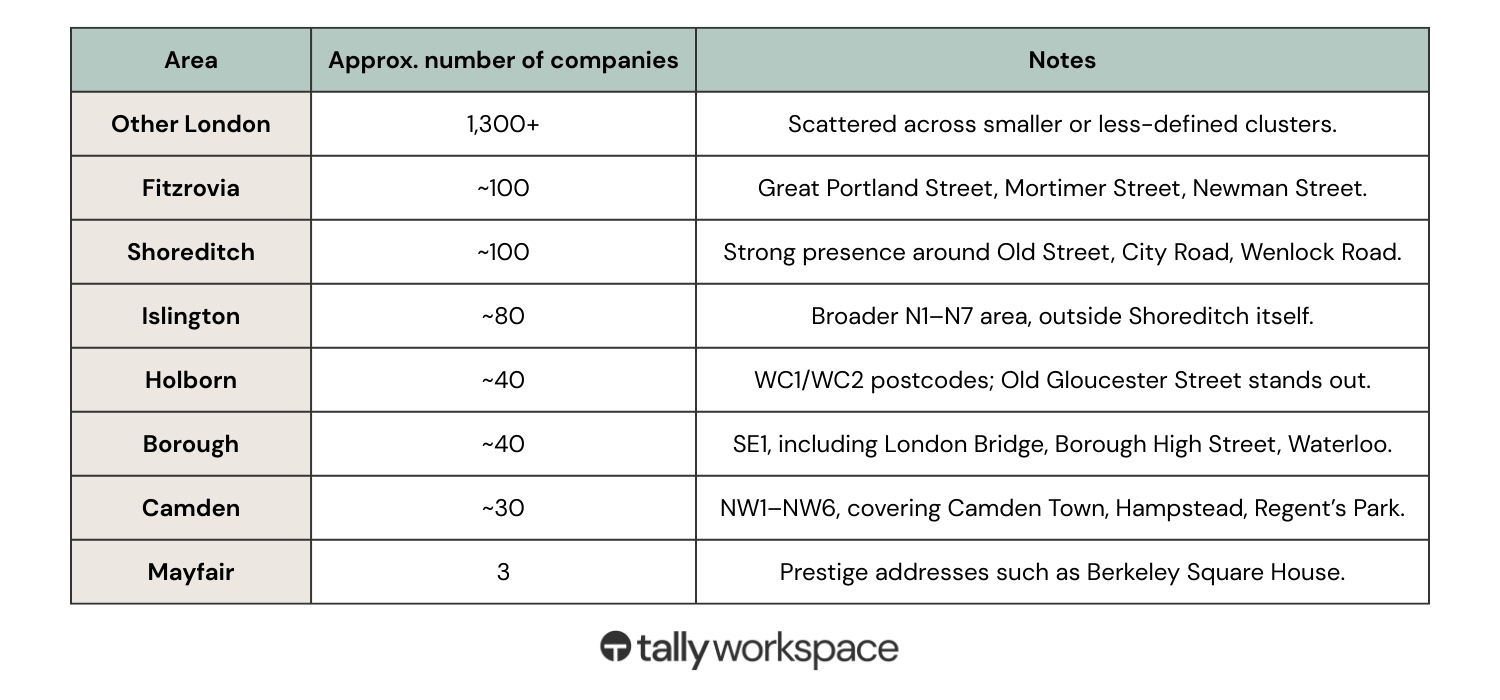
Our deep-dive analysis of Companies House data confirms where most of the action is happening:
Overall, London’s AI firms are distributed widely, but with distinct concentrations around Fitzrovia, Shoreditch, and King’s Cross. These areas offer the right mix of talent, transport, and networking — and that’s shaping where the next wave of AI growth will take place.
Housed in Techspace’s flagship 80,000+ sq ft redevelopment of a former gin distillery, the Hub brings together entrepreneurs, academics, investors, and policymakers under one roof. It’s more than just office space: members have access to a curated programme of events, workshops, and networking opportunities, alongside state-of-the-art facilities designed for high-growth AI teams.
Techspace Goswell Road itself sets a new bar for premium, sustainable workspaces in London. The building holds a BREEAM Excellent rating and comes equipped with:
Shared spaces built for workshops, showcases, and demos
The Hub has already attracted an impressive community. Companies like Harriet, Culted, Whalar, and Quench AI (founded by Kassai himself) are based here, alongside a growing list of early-stage AI startups and scaleups. The result is a high-density ecosystem where collaboration happens naturally, and access to investors, regulators, and talent is only a few desks away.
“The London AI Hub empowers and mobilises the UK’s AI community to ensure the UK remains a leading innovator on the global stage.”
Policy leaders agree. Peter Kyle, Secretary of State for Science, Innovation, and Technology, has highlighted the Hub as proof of the UK’s ambition to “turbocharge” AI. And Jonathan Bevan, CEO of Techspace, has called the Goswell Road launch a milestone, describing the Hub as “a space that inspires and empowers innovation.”
For AI companies, the appeal of the Hub is clear. It offers proximity to decision-makers — from policymakers to venture capital investors — as well as a recognised base within London’s thriving AI ecosystem. The programme of events and workshops gives members opportunities to engage with the latest thinking on responsible AI, commercialisation, and scaling. Just as importantly, the flexible, high-quality workspace is designed to grow with teams as they expand.
In just a few months, the London AI Hub has shifted from an ambitious idea to a working reality — one that’s helping shape the future of AI in the UK right now.
What this means for the future of workspaces for AI companies
The way AI companies approach their offices in 2025 looks very different from the last wave of tech growth. These aren’t sprawling teams filling floor after floor, but smaller headcounts with far higher investment per person. A 20-person AI startup might demand the kind of infrastructure once reserved for corporates — secure networks, soundproofed meeting rooms, wellness areas, and premium coffee on tap.
Hybrid working still plays a role, but unlike many SaaS startups that leaned heavily into remote-first models, AI companies are placing greater value on in-person collaboration. Their teams are often made up of researchers, engineers, and product leads who want to test, iterate, and problem-solve together. That changes the function of the office: it becomes less about rows of desks and more about collaboration zones, specialist labs, and spaces that encourage idea-sharing.
Amenities matter more than ever. AI companies know that talent is their biggest competitive advantage, so they’re investing in high-end, hospitality-style features that help attract and retain the best people — from cycle storage and showers to gyms, catered lunches, and barista coffee. The workplace isn’t just a cost centre; it’s part of the package that convinces someone to join and stay.
Location choices also reflect business strategy. Startups focused on life sciences are clustering near research hubs like King’s Cross. Those building financial AI tools are choosing Canary Wharf or Moorgate. Creative AI companies lean towards AI-driven office space in Shoreditch or Soho, where the energy of the neighbourhood aligns with their brand. The address on the door is more than symbolic; it signals to clients, partners, and future hires what kind of company you are.
These shifts are already reshaping London’s office market. Workspace providers are adapting quickly, tailoring fit-outs and services for AI firms whose needs don’t match the SaaS playbook of the 2010s. Expect to see more flexible contracts, buildings wired for high-security infrastructure, and premium amenities that blur the line between workplace and hospitality. For landlords and providers, it’s a reminder: AI companies may take up fewer desks, but their standards — and expectations — are far higher.
Offices that match AI teams’ ambitions
Whether you’re a two-person research team or a scale-up raising your Series B, the workspace you choose will influence your ability to hire, fundraise, and, ultimately, grow.
At Tally Workspace, we help AI companies discover flexible, inspiring offices across London’s hottest tech neighbourhoods — from Shoreditch lofts to King’s Cross labs — and even the London AI Hub itself.
The right space does more than give you an address; it gives you a seat at the table of the world’s most dynamic AI community.
Explore office space in London
Priority neighbourhoods with deep coverage across the city.
Jules Robertson is the Co-Founder of Tally Workspace, where she leads on commercial strategy, growth, and product development. With a background in strategy consulting and a drive to fix real-world inefficiencies, Jules co-founded Tally Workspace to make the office search process more transparent, modern, and user-friendly for today’s hybrid teams.
From first office to scale-up headquarters, we have been there.
Secured a 14,000 sq ft CAT A leased HQ at White City Place
Introduced to 3 specialist fit-out partners, including Thirdway
Full market review spanning White City, Hammersmith & Soho
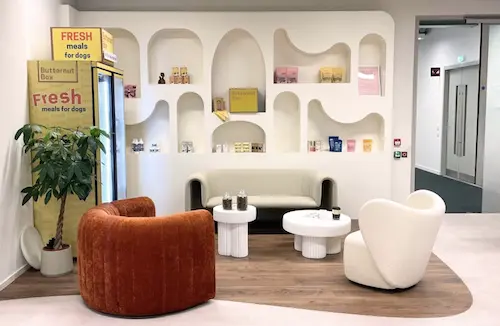
"Much like Butternut Box's brand, the project intent has been to pair a deeply human playfulness with elevated, premium design. Together we've crafted a joyful space which can bring out the best in all users, whether they be two or four legged."
"Tally helped us find our new office at lightning speed. Jules, Laura, and the team are the best at what they do. We wanted a rooftop, natural light, a central location, and a good deal. They got us 10+ solid options within 48hrs and scheduled all the viewings. We found our new space within 2 weeks."
Full market review across serviced, managed and leased office options
Custom layout designed by a workspace specialist - at no extra cost
Secured a self-contained 1,850 sq ft space in Leicester Square
"Tally Workspace exhausted the market and found us just what we were looking for within weeks. They were a breath of fresh air, extremely knowledgeable and helpful, and even assisted with design and fit-out. Very proactive at every stage, like an extension of our own team."
Secured a 2,000 sq ft self-contained HQ in Shoreditch
Workspace designer sourced and managed as part of the service
Used Tally Workspace on-demand between offices
"Tally Workspace has been an incredible help for Sifted. From understanding the office/remote first landscape to finding the right office for all of our requirements."
Shortlisted options across Marylebone, Victoria, Waterloo & Holborn
Secured a 60-desk office with internal meeting rooms in TCR
"You made this whole project smooth and actually enjoyable. You're well connected, which opened up options we wouldn't have found ourselves. I'm confident we would have missed this fantastic opportunity without your help, and you secured us a much better price than we could have achieved directly."
"I'd say it is a no brainer! A win win to use Tally Workspace to find your next space. No additional cost but endless extra value."
Founder & Lightning
"Not only are they very knowledgeable about the market, but they're lovely people to deal with. We're so happy with our final choice and can't wait to move!"
Finance Unlocked
"The space they found was perfect for our team, with loads of amazing breakout space, beautiful meeting rooms and a real emphasis on wellbeing."
Florence
"They got us 10+ solid options within 48hrs and scheduled all the viewings. Highly recommend. We found our new space within 2 weeks."
Cryptio
How Tally Workspace works
Tell us what you need
Team size, budget, location, and deal breakers. We'll ask about the things most people forget too.
searching...
We handle the search
We search our proprietary database then call landlords directly about unlisted spaces. Often back to you within a day.
We handle the detail
Contracts are where most searches fall apart. We review everything and negotiate before you sign.
You move in confident
Best space, best terms, timeline that fits your growth. You know exactly what you're signing.
Tell us what you're looking for
Find an office today
Using our extensive mapping of startup and scaleup office space, find an office that fits your needs and your culture in just a few minutes.