Consistent sleep and mindful morning routines enhance focus and productivity in remote work.
Setting clear boundaries and dedicated workspaces helps prevent burnout.
Utilizing task management tools can significantly improve workflow and efficiency.
Say goodbye to cubicles and coffee breaks.
Now, we embrace the flexible, and sometimes chaotic, world of remote work.Feeling like time slips away unnoticed and struggling to manage your work schedule?Don't worry, we've got you covered with our top 5 tips:
1) Small tweaks, big impact: quick wins for time management
Navigating remote freedom without structure can be tricky.
While some thrive, others miss the routine and lose precious hours to distractions.Don't underestimate the power of tiny tweaks.
Consistent sleep
Stick to a schedule. Even on weekends, for improved focus and a happy internal clock. Aim for consistent sleep times (7-8 hrs for adults).
Mindful start
Start the day feeling calm and clear-headed. The New York Times suggest practising meditation to lower stress and boost focus. Dedicate 30 minutes to meditation, journaling, or stretches before diving in.
Plan your day
List your top 3 priorities with realistic timeframes to avoid feeling overwhelmed. Keep it concise, action-oriented, and inclusive.
Morning stand-up
Gather your team for a quick pep talk. Celebrate wins, outline goals, and tackle roadblocks as a unit. Sprinkle in banter and aim for 10-15 minutes of focused conversation.
2) Beat burnout and procrastination
Remote work's flexibility can breed burnout.
Set clear boundaries as work and home lines blur.
Strategic recharge breaks Schedule breaks in your calendar. Take a mindful walk, do a quick workout, meditate, or listen to a funny podcast.
Dedicated workspace Find a quiet, distraction-free space at home. Personalise it to create boundaries and focus. Invest in good furniture like an ergonomic chair.
3) Ditch the distractions
Everyone knows the spreadsheet-to-Instagram rabbit hole.
Combat distractions with these two expert-backed tips:
Digital detox
Shut down distractions during work sprints. Use "Do Not Disturb" on your phone and apps.
Set healthy boundaries
Set clear expectations with family or flatmates. Explain you need minimal interruptions during focus time.
4) Plan for Peak Performance
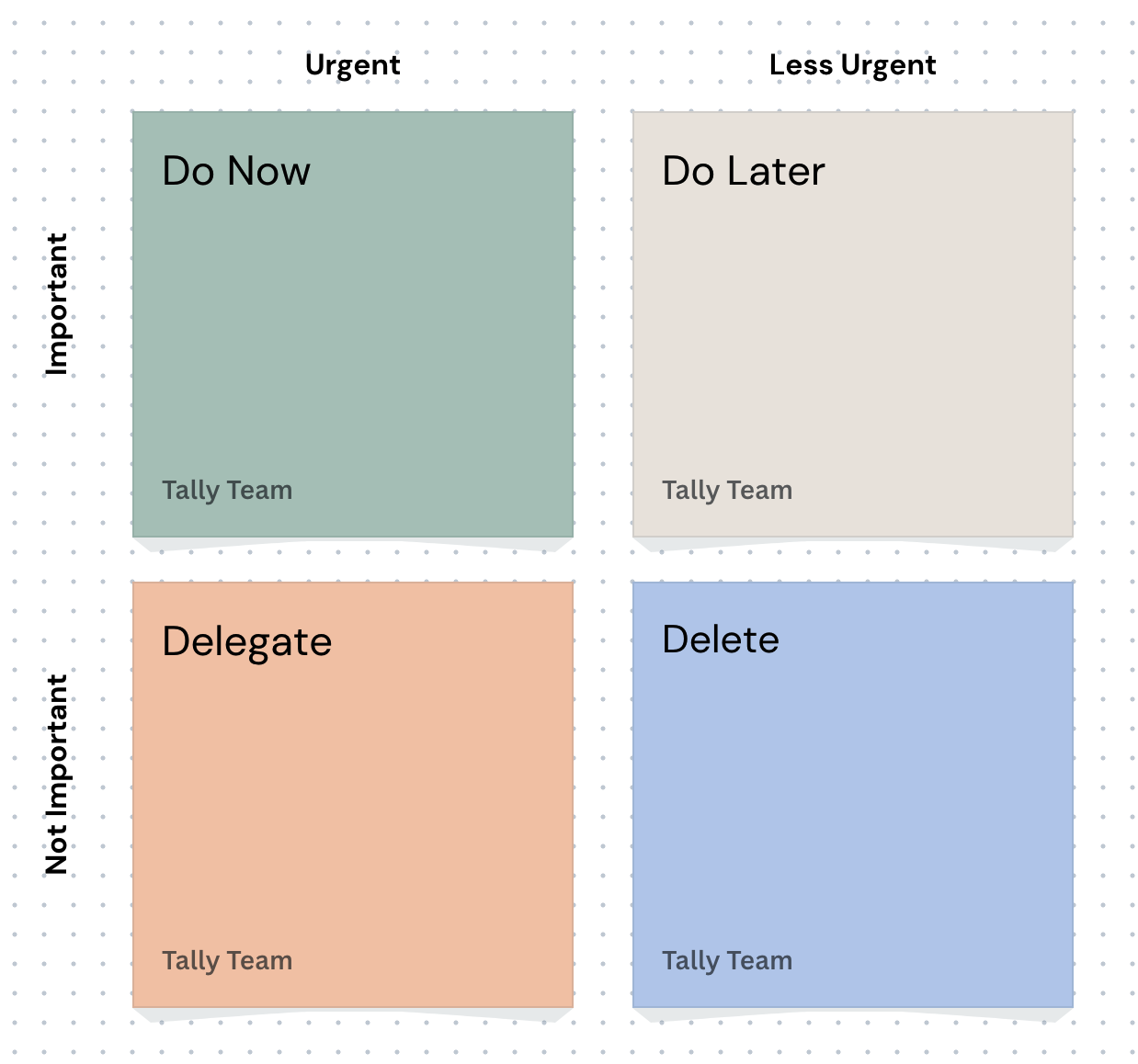
Need help with your workflow?
The Eisenhower matrix can help you categorise tasks quickly:Do now: Urgent and important tasks (deadlines, reports).Schedule later: Important but not urgent tasks (meetings, planning).Delegate/outsource: Urgent but not-so-important tasks (emails, errands).
Delete: Not urgent and unimportant tasks (distractions).
Jules Robertson is the Co-Founder of Tally Workspace, where she leads on commercial strategy, growth, and product development. With a background in strategy consulting and a drive to fix real-world inefficiencies, Jules co-founded Tally Workspace to make the office search process more transparent, modern, and user-friendly for today’s hybrid teams.
From first office to scale-up headquarters, we have been there.
Secured a 14,000 sq ft CAT A leased HQ at White City Place
Introduced to 3 specialist fit-out partners, including Thirdway
Full market review spanning White City, Hammersmith & Soho
"Much like Butternut Box's brand, the project intent has been to pair a deeply human playfulness with elevated, premium design. Together we've crafted a joyful space which can bring out the best in all users, whether they be two or four legged."
"Tally helped us find our new office at lightning speed. Jules, Laura, and the team are the best at what they do. We wanted a rooftop, natural light, a central location, and a good deal. They got us 10+ solid options within 48hrs and scheduled all the viewings. We found our new space within 2 weeks."
Full market review across serviced, managed and leased office options
Custom layout designed by a workspace specialist - at no extra cost
Secured a self-contained 1,850 sq ft space in Leicester Square
"Tally Workspace exhausted the market and found us just what we were looking for within weeks. They were a breath of fresh air, extremely knowledgeable and helpful, and even assisted with design and fit-out. Very proactive at every stage, like an extension of our own team."
Secured a 2,000 sq ft self-contained HQ in Shoreditch
Workspace designer sourced and managed as part of the service
Used Tally Workspace on-demand between offices
"Tally Workspace has been an incredible help for Sifted. From understanding the office/remote first landscape to finding the right office for all of our requirements."
Shortlisted options across Marylebone, Victoria, Waterloo & Holborn
Secured a 60-desk office with internal meeting rooms in TCR
"You made this whole project smooth and actually enjoyable. You're well connected, which opened up options we wouldn't have found ourselves. I'm confident we would have missed this fantastic opportunity without your help, and you secured us a much better price than we could have achieved directly."
"I'd say it is a no brainer! A win win to use Tally Workspace to find your next space. No additional cost but endless extra value."
Founder & Lightning
"Not only are they very knowledgeable about the market, but they're lovely people to deal with. We're so happy with our final choice and can't wait to move!"
Finance Unlocked
"The space they found was perfect for our team, with loads of amazing breakout space, beautiful meeting rooms and a real emphasis on wellbeing."
Florence
"They got us 10+ solid options within 48hrs and scheduled all the viewings. Highly recommend. We found our new space within 2 weeks."
Cryptio
How Tally Workspace works
Tell us what you need
Team size, budget, location, and deal breakers. We'll ask about the things most people forget too.
searching...
We handle the search
We search our proprietary database then call landlords directly about unlisted spaces. Often back to you within a day.
We handle the detail
Contracts are where most searches fall apart. We review everything and negotiate before you sign.
You move in confident
Best space, best terms, timeline that fits your growth. You know exactly what you're signing.
Tell us what you're looking for
Find an office today
Using our extensive mapping of startup and scaleup office space, find an office that fits your needs and your culture in just a few minutes.